
Notes from the Fault Line
The Lost Generation, AmFest, Brown, MIT & Minnesota


Between Christmas, Hanukkah, kids home from school, and the general blur that descends every December, you are getting about a third of my usual output today. Not because the moment lacks importance, but because it has too much of it.
So instead of a single, polished argument, think of this as a series of flags planted on contested ground. Signals worth noticing. Threads worth pulling. Homework worth doing on your own.
Enough prologue. Here is what lodged in my mind this week.
I. The Brown–MIT Murders and the Sound of Static
I cannot even remember whether the Brown shooting was this week or last, which in itself tells you something about the state of modern America. Tragedy now moves faster than memory.
The timeline blurs in the holiday haze, but the official account of the spree feels distinctly off-kilter. On December 13, 2025, Claudio Manuel Neves Valente, a former Brown University graduate student, allegedly stormed into a classroom during finals week, shouting incoherently before opening fire. He killed two students, Ella Cook, the vibrant head of the College Republicans, and Mukhammad Umurzokov, and wounded nine others in a burst of calculated violence.
From there, the rampage shifted to MIT, where Valente murdered Nuno Loureiro, a leading nuclear physicist and director of the Plasma Science and Fusion Center. We are told they shared an academic past in Portugal three decades ago, but the connection seems thin at best. My first instinct leaned closer to Alex Lightman’s hypothesis: that this may have been an Iranian hit, or the work of another state actor, designed to shield hydrocarbon cartels from real competition, something not unlike the premise of The Three-Body Problem, if you know the book.
None of us have access to the full investigative dossier, but the surface details raise eyebrows. Why target a student Republican leader and a top-tier scientist in such disparate locations? The connections feel contrived, the motives opaque. Adding to the unease: Brown University abruptly scrubbed websites featuring a particular student activist on December 16, just hours before a press conference where officials claimed ignorance of any such deletions. Social media profiles vanished in tandem, sparking a Streisand effect that only amplified suspicions.
We are told not to speculate. We are told to wait. We are told that asking questions is irresponsible.
But on its face, the story does not quite sit right. The target selection. The sequencing. The speed with which digital footprints disappear. The gross institutional incompetence and silence (“No, we didn’t interview any eyewitnesses”). None of this proves anything. But it does justify skepticism.
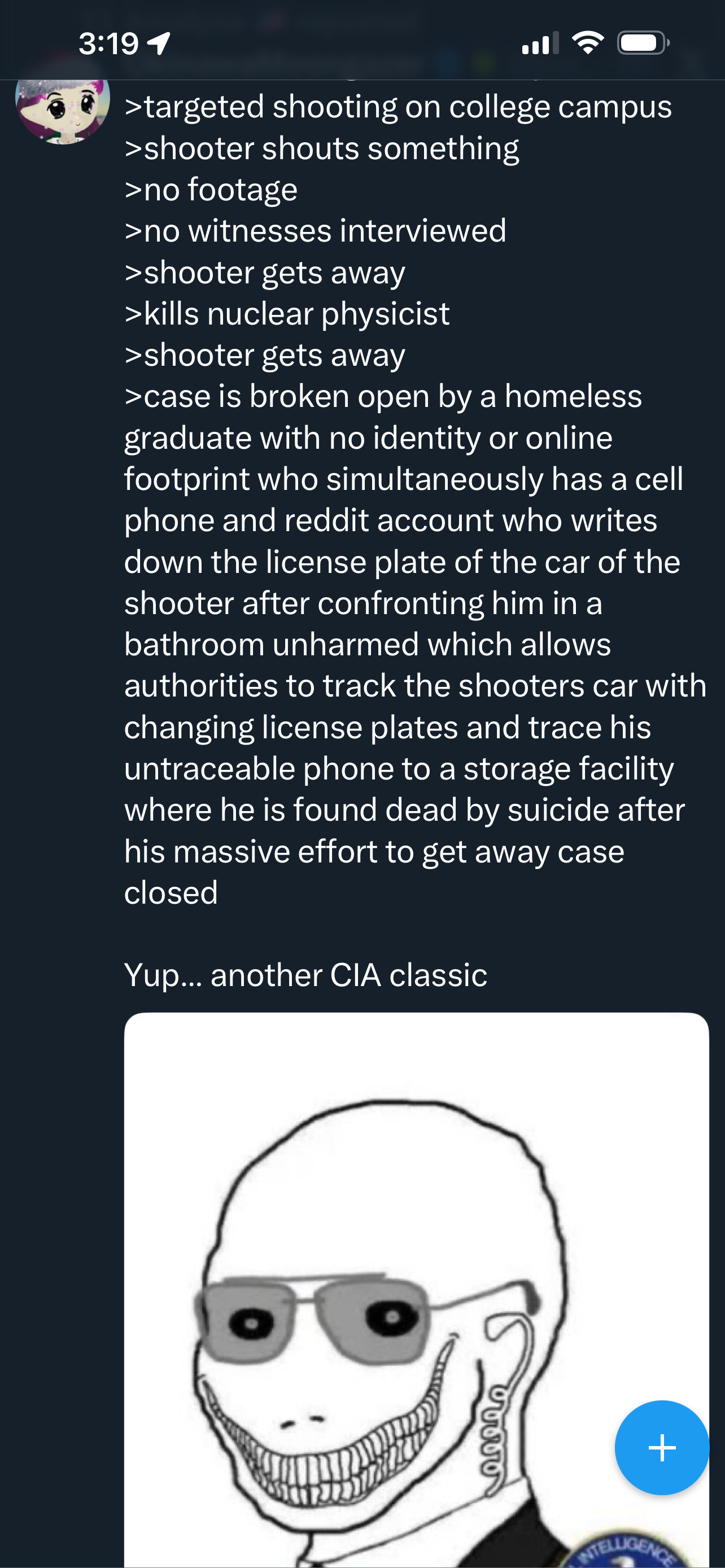
When institutions lose credibility, people stop accepting their explanations by default. That is not paranoia. That is pattern recognition.
If you want a deeper dive into why this episode feels off, and how America’s elite universities continue to devolve into hotbeds of Red-Green antifa and jihadist convergence, I recommend my friend Yuri’s analysis. Not because he has all the answers, but because he asks the questions others are afraid to raise.

II. AmFest and the Fracturing of the Right
Last week I wrote about the two factions pulling the American Right apart. Some have melodramatically called it a “civil war,” which is probably the wrong metaphor. Civil wars imply two roughly equal sides.
This is not that.
What we are watching is a small but loud faction of anti-American, anti-Jewish, anti–Western civilization actors punching far above their weight. Some are ideologues. Some are foreign-aligned. Some are grifters chasing clicks. Some are useful idiots with no historical grounding or moral ballast. And some are cowards hedging their bets, waiting to see which way the wind blows before taking a stand.
AmFest, hosted by Turning Point USA, was the latest battlefield in this fight. And if the analogy holds at all, it was less Fort Sumter and more Gettysburg. A moment where lines became clearer, even if the war itself is far from over.
The conference itself was a mixed bag. It was disappointing to see the continued elevation of figures who have spent the last year laundering talking points that align neatly with Qatari state interests, Russian civilizational nihilism, or outright Islamist apologetics. Soap opera masquerading as strategy. Personality cults standing in for policy.
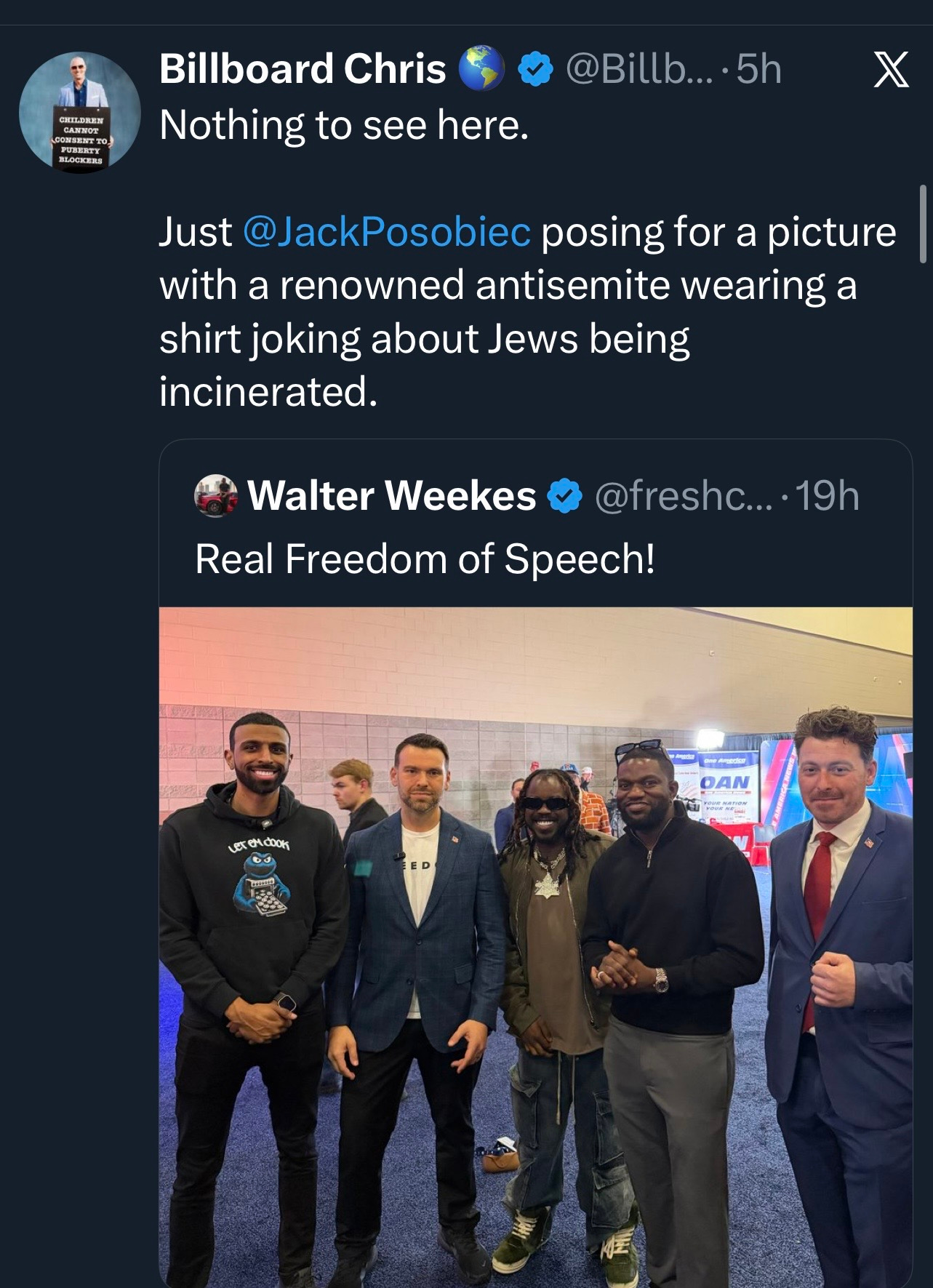
The Right has become unserious, mired in soap-opera feuds between TPUSA and clownshow grifters like Candace Owens-Tucker Carlson, and dick-measuring contests over “Heritage American” purity.
We don’t need the false concept of Heritage Americans to rationally state that the Somali influx into Minnesota is not good for America (more on this later).
One of the radical ideas at the heart of the American founding is not merely that men are created equal, but that lineage confers no moral rank.
What matters here is not who your ancestors were, how long ago they arrived, or what boat they stepped off. What matters is what you do with the freedom you inherit in your own lifetime.
The notion that someone is a “better American” because their forebears arrived earlier than someone else’s is alien to the American Experiment. It reeks of hereditary class, of bloodlines and titles, of the Old World hierarchies this country was explicitly designed to escape.
Be proud of your family history. You should be. We all should be.
But the moment you claim superior American status because your family arrived sooner, you are not defending America. You are betraying it.
That belief does not honor your ancestors. It spits on the very reason they came here in the first place.
We do not have titles of nobility. We do not inherit virtue. We do not pass down worth through blood.
In America, your value is not who you came from. It is who you choose to become.
Pride in our heritage is healthy. Gratitude for those who came before us is proper. But neither requires a political program, nor demands special recognition for long bloodlines, in a nation founded on the deliberate irrelevance of bloodlines altogether.
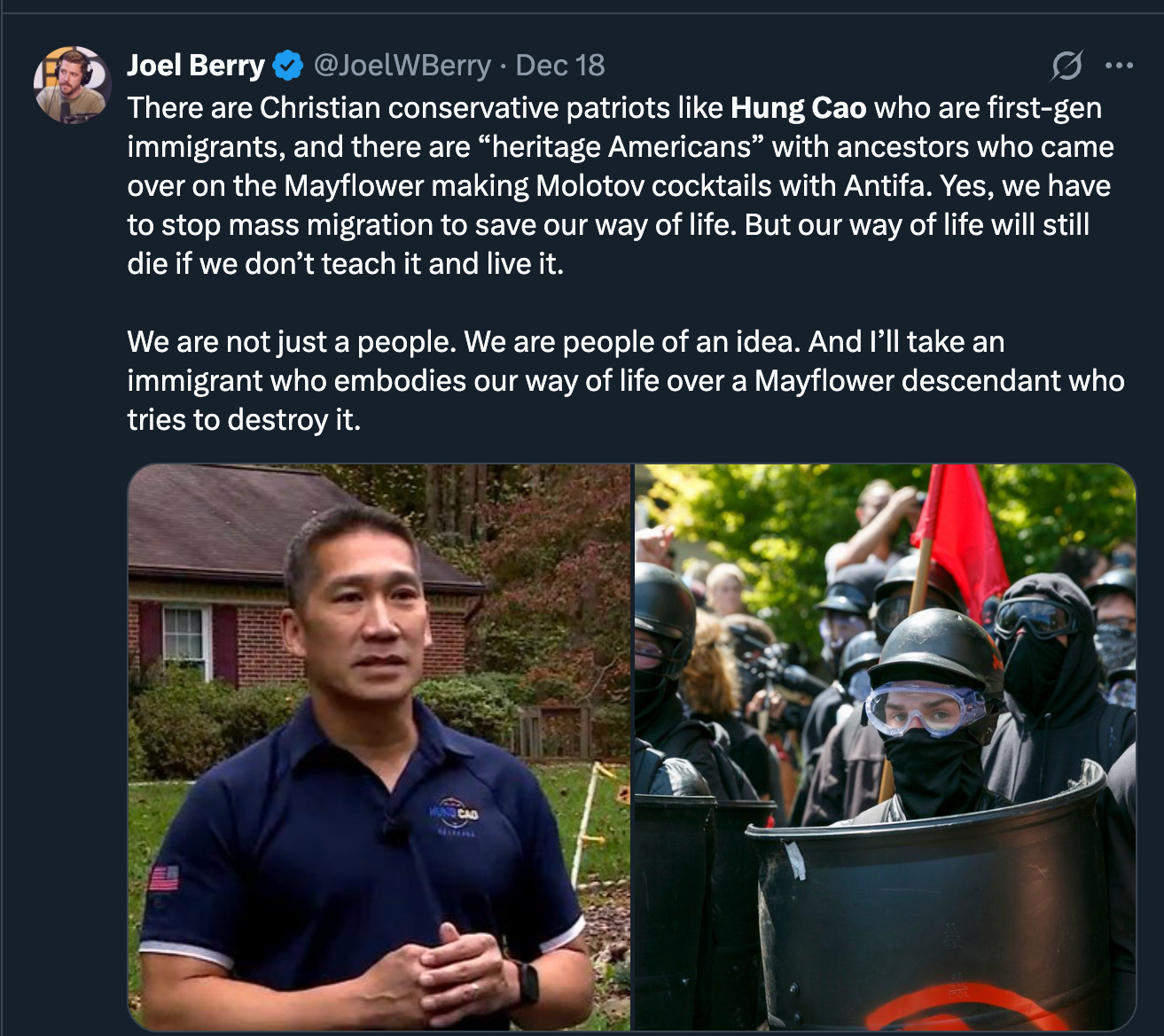
Patty Hearst’s family history stretches back before the Declaration of Independence. And yet I would take Hung Cao, a first-generation Vietnamese immigrant and military veteran, any day of the week over a subversive radical. There are millions of such examples, and they all point to the same truth.
Meanwhile, real problems metastasize. Islamic extremism is resurgent. Russia is expansionist again. China has already crossed the Rubicon economically and technologically. Hezbollah operates freely in South America. And too many Republican influencers are more interested in podcast circuits and Epstein-adjacent rehab artists than in governing.
The Right survives only because the Left has become even more unserious.
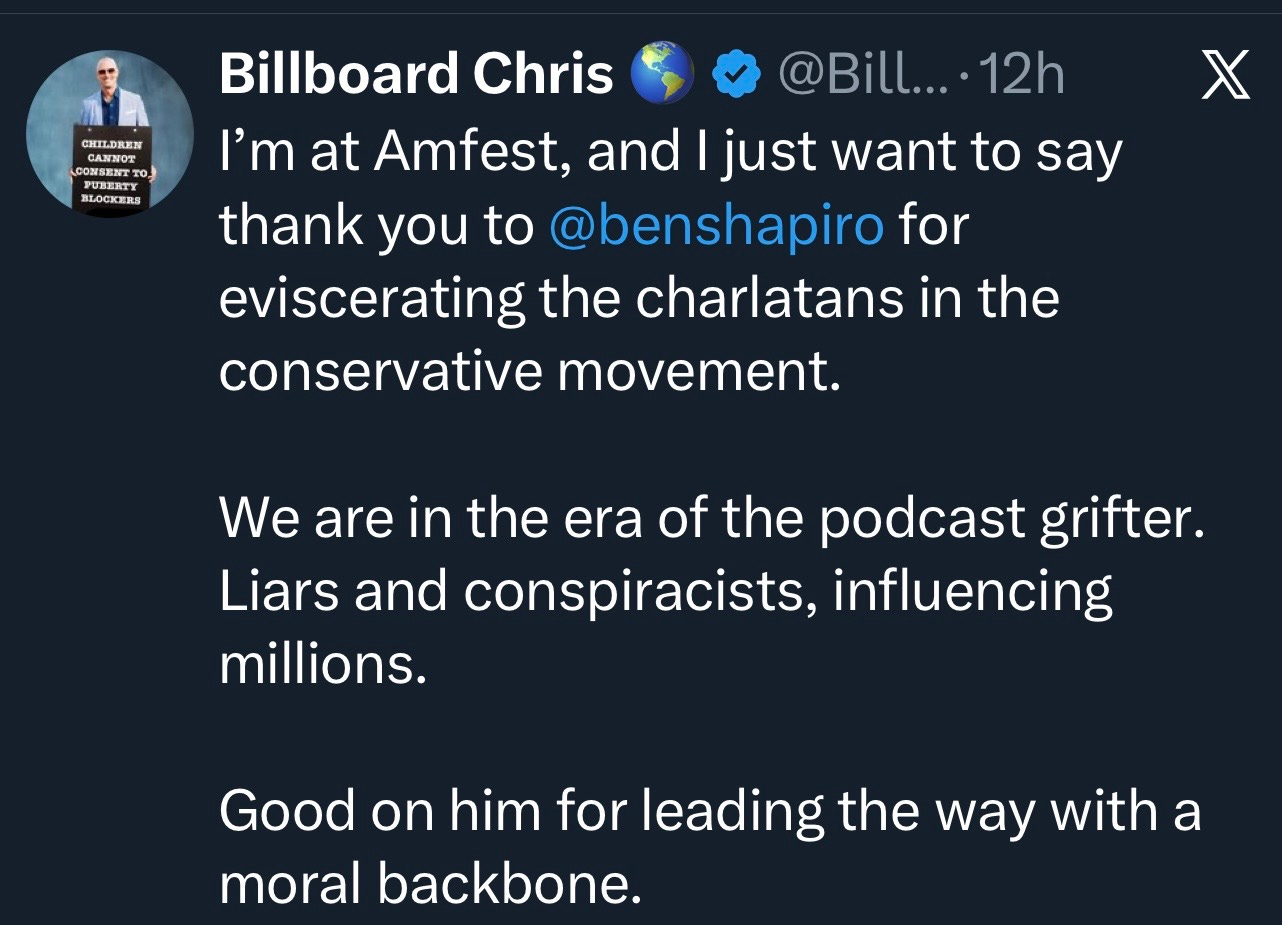
Into this chaos stepped Ben Shapiro.
I say this without enthusiasm for personality worship. I wish for a variety of superficial yet pragmatic reasons he were not the standard-bearer by default. But when others refuse to lead, those willing to speak plainly inherit the role.
As David Bahnsen aptly put it, “Somebody went full Buckley today. The most courageous 20 minutes for any conservative in many years. This is what fearless conviction looks like. This is how the right conserves its soul.”
His speech was not an attack. It was an indictment. And more importantly, it was a framework.
Shapiro articulated five duties that anyone who speaks to a political audience owes them.
First, truth. Not vibes. Not insinuation. Not “just asking questions.” Truth.
Second, principle over personal feeling. Friendship with powerful people is not a moral exemption.
Third, responsibility. If you platform someone, you own the questions you fail to ask.
Fourth, evidence. Conspiracy without proof is not courage. It is laziness.
Fifth, solutions. Despair is not wisdom. If you convince people they are powerless, you guarantee they will be.
This framework elevates discourse, treating audiences as partners in sense-making rather than marks for grift. Fraudsters operate oppositely; change comes when followers demand better.
This was not censorship. It was moral clarity.
Those who felt attacked felt exposed.
Predictably, the response from the usual suspects was to reframe the speech as an assault on free speech. This is nonsense.
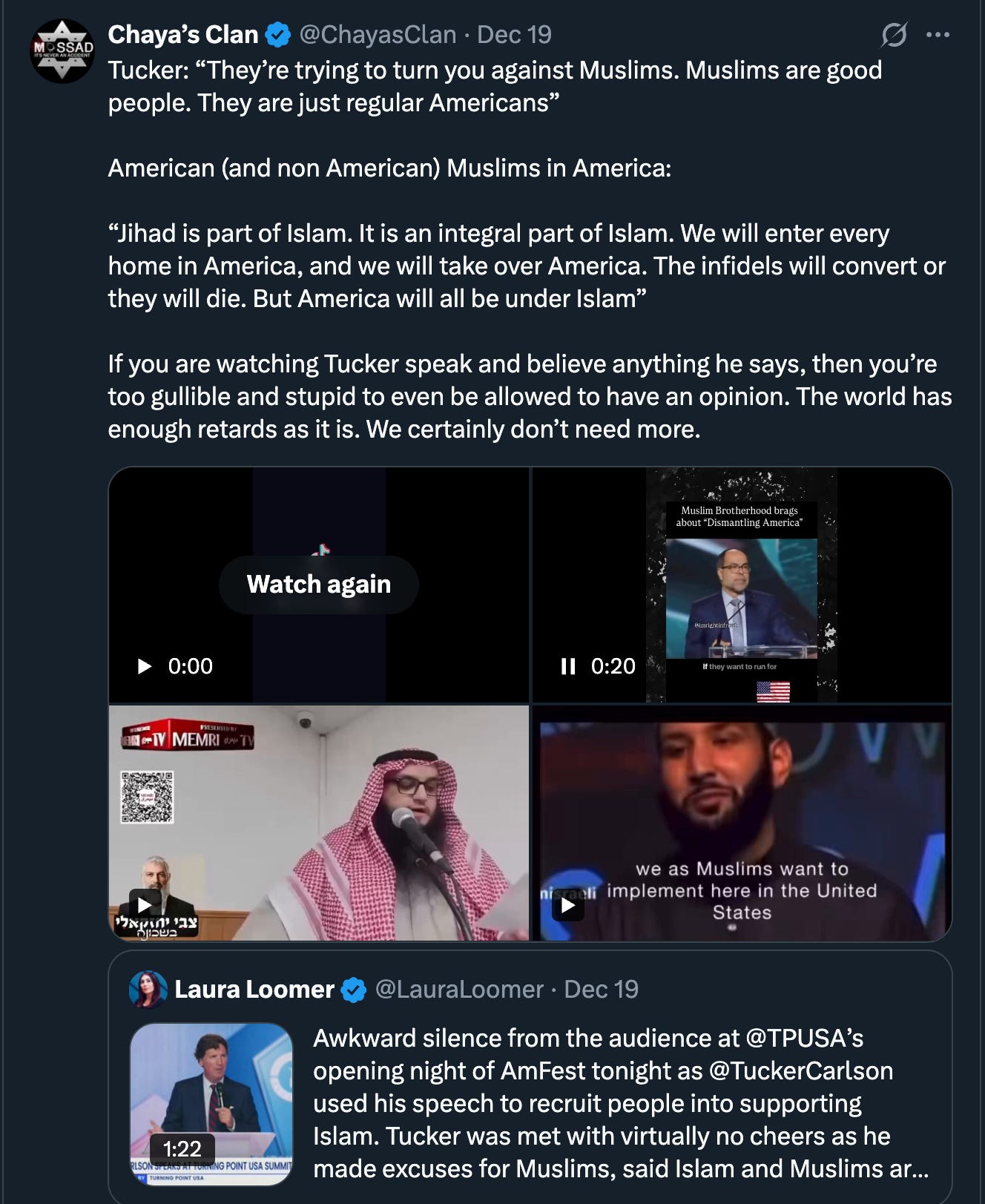
Predictably, the criticized crew, their positions indefensible, especially Tucker’s elevation of the chaos agent Candace Owens, recast Shapiro’s argument as a “war on free speech” and an act of deplatforming. That is rubbish. No one is silencing them. Tucker commands a massive podcast, financed amid curious ties to Muslim Brotherhood sympathizer Malik Omar, and has hosted conversations with Alexander Dugin and Vladimir Putin, a far cry from his former posture as a pro-Trump stalwart and a clear pivot toward a more openly anti-Western critique.

What is being demanded is accountability.
As David Horowitz once put it, refusing to platform destructive ideologies is not censorship. It is editorial judgment. A movement that cannot agree on a coherent worldview will never conserve anything.
Tucker Carlson did not drift accidentally into Islamist apologetics or Duginist romanticism. This was a turn, not a stumble. It coincided neatly with Qatari patronage and a sudden enthusiasm for civilizational enemies of the West.
None of this is random.
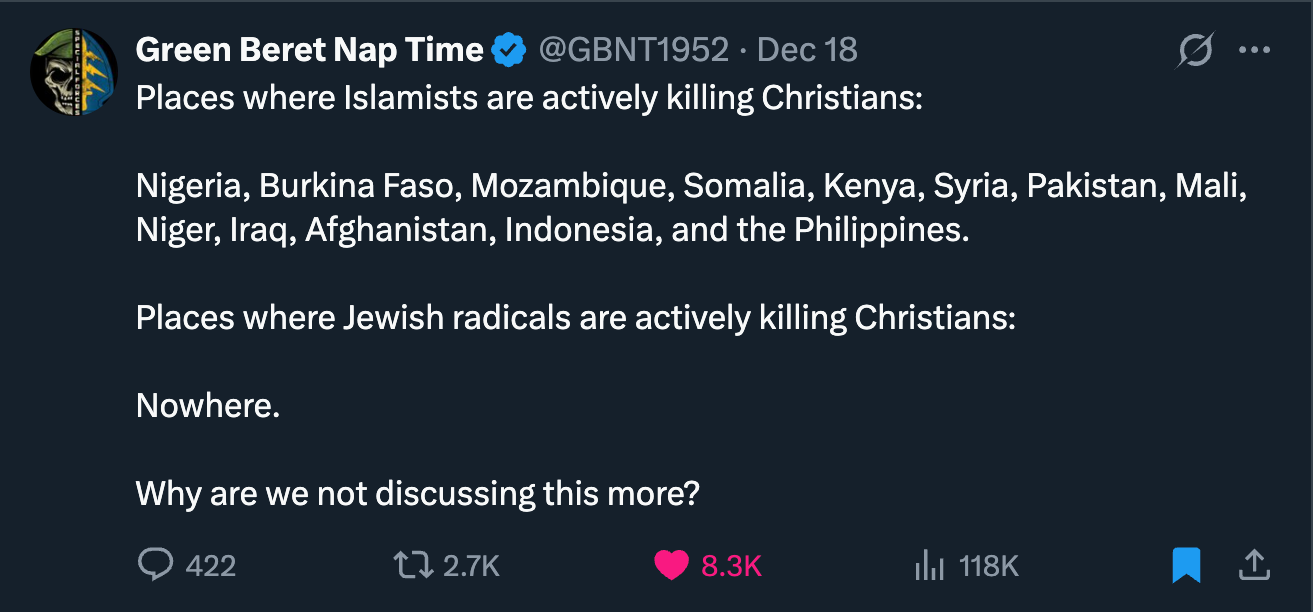
The reflexive “blame the Jews for everything” crowd finds its talking points aligning, almost too neatly, with the core doctrines of the Muslim Brotherhood. Through Qatar’s influence and the weakness and demoralization of the Biden era, these ideas have seeped into and captured institutions across America and Western Europe.
Into this vacuum steps Ben Shapiro. As too many other supposed luminaries on the right retreat into silence or cowardice, his willingness to pick up the torch and make the intellectual and moral case for actual conservatism has left him, for now, as its most visible spokesperson.
III. Islamism Is Not a Phantom Threat
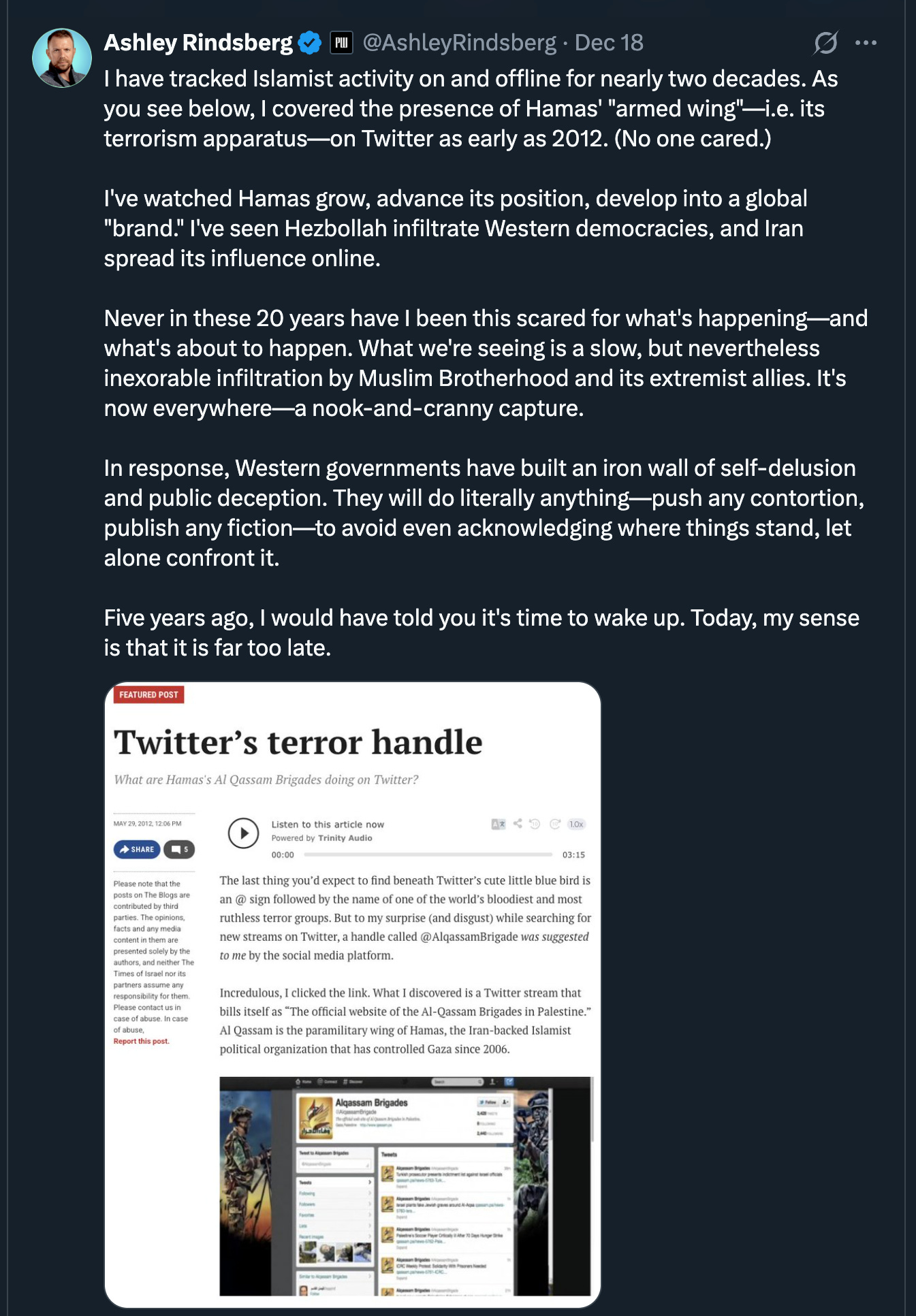
Which brings us to the elephant in the room. Islamism remains the greatest ideological threat to the modern world.
This is not a statement about individual Muslims. Millions are peaceful, decent people. Many are trapped under systems they did not choose.
But Islamism is not a fringe phenomenon. It is not a rounding error. It is not comparable to the marginal extremists found in other religions. In many Muslim-majority societies, hardline views command substantial minority or even majority support. That matters.
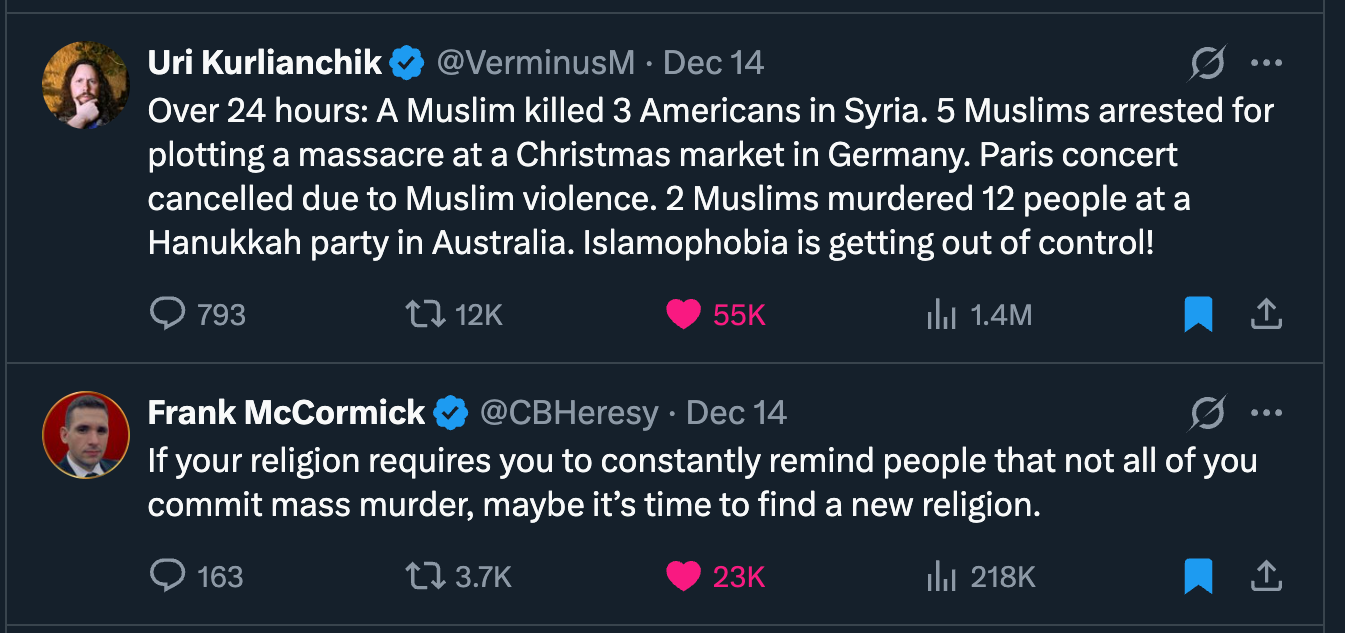
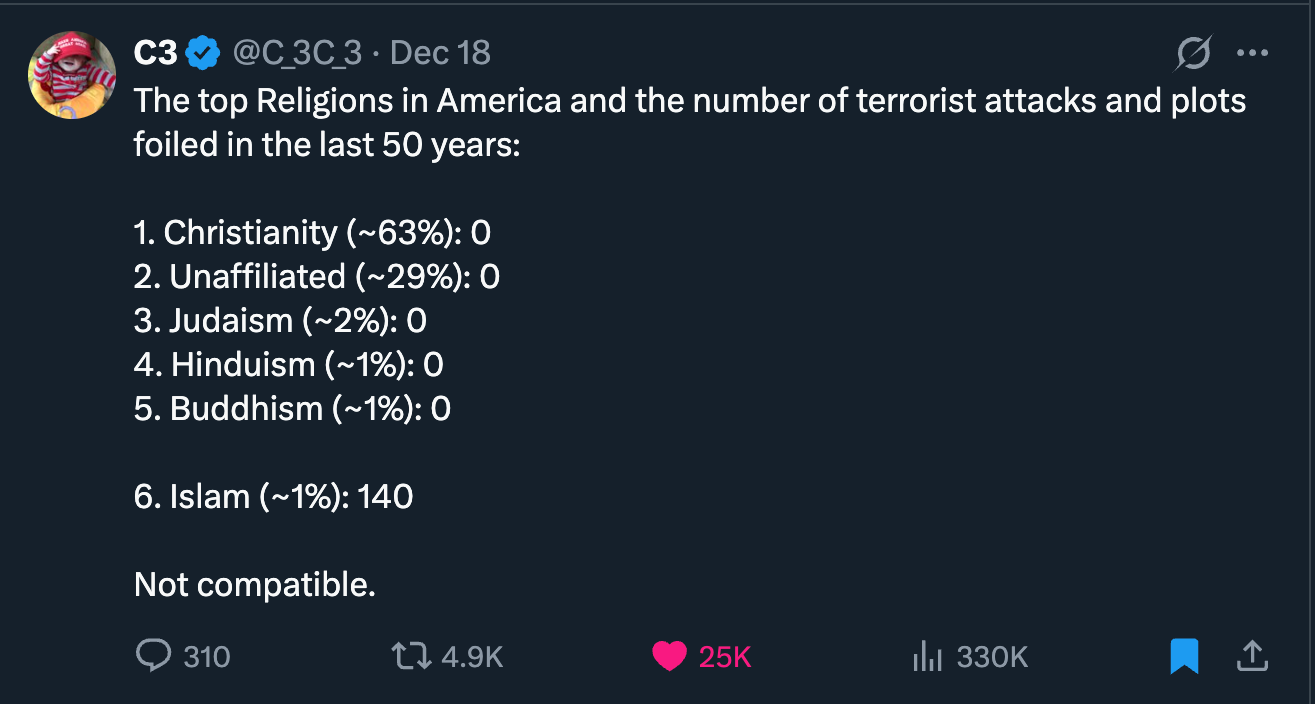
Globally, we’ve witnessed over 65,000 attacks since 9/11, 98% Islamist per some estimates, though numbers vary.

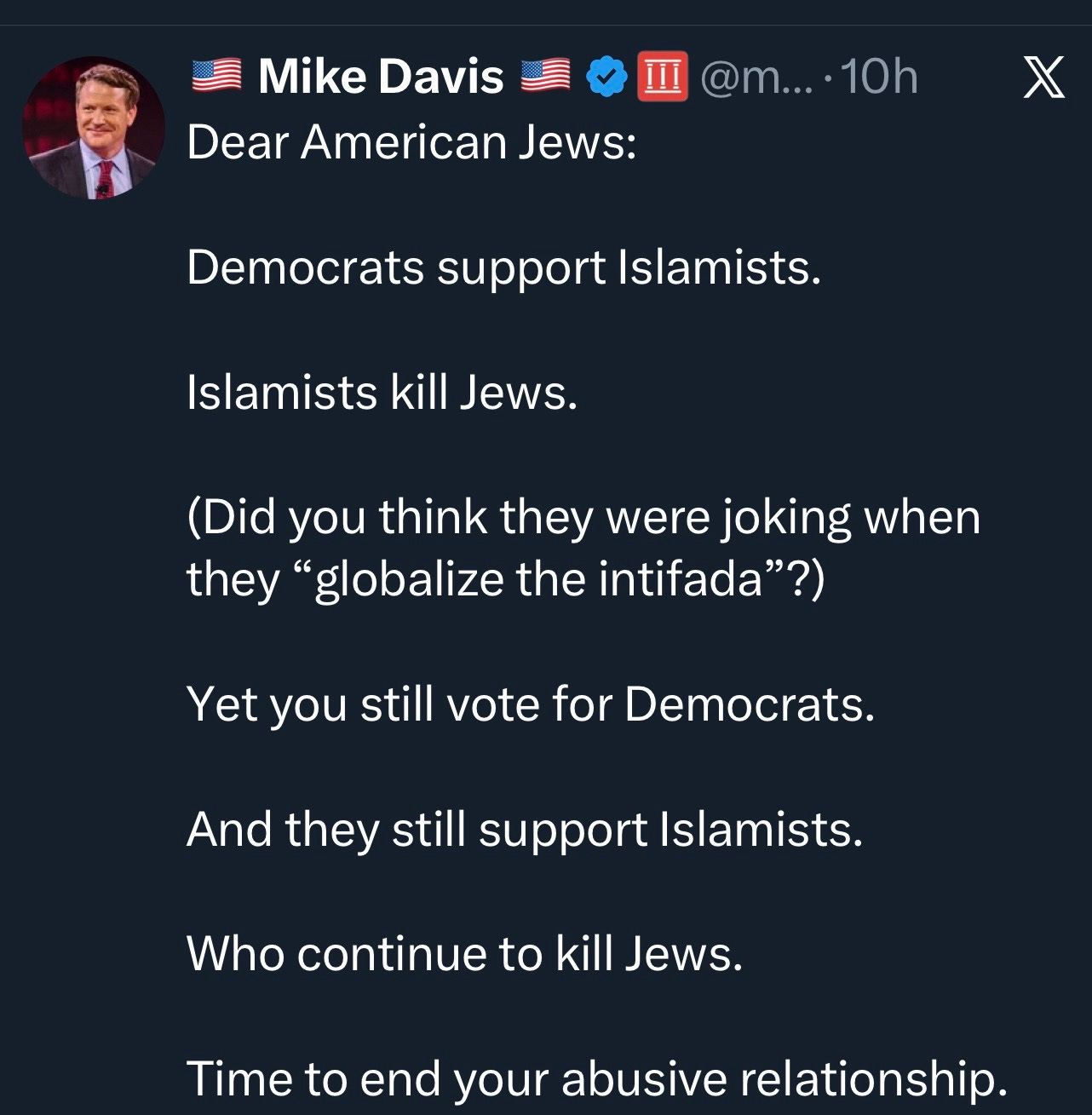
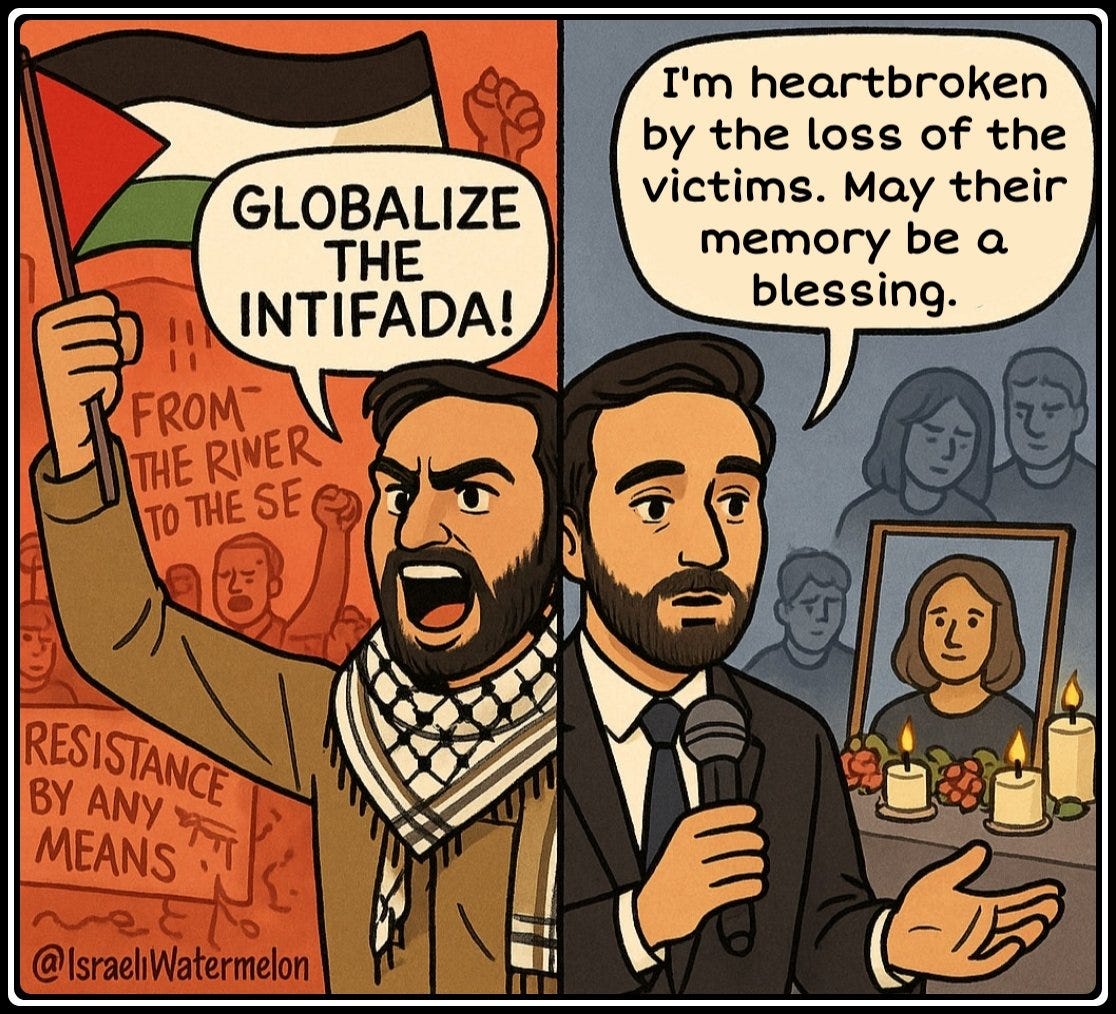
What we are witnessing now is the early phase of a global intifada. Jews are the first target, as history reliably predicts. Christians and secular Westerners follow, along with any other infidels blocking the Caliphate dream. The theology is explicit about this.
Unlike other faiths where radicals hover below 1%, polls suggest 25% or more of Muslims justify murder and bombings in ‘defense’ of Islam, with higher sympathy in some regions.
This asymmetry demands vigilance.
The defining question of our time is how liberal societies distinguish between those who can integrate into pluralism and those who reject it outright. That problem has no easy answer, but pretending it does not exist guarantees failure.
In the meantime, the threat vector is obvious. The United States imported millions of people in the last several years with little to no vetting. Statistically, some portion includes criminals, extremists, and hostile actors. In a free society with advanced weapons and soft targets, it does not take many to create unthinkable chaos and carnage.
Serious countries act accordingly.
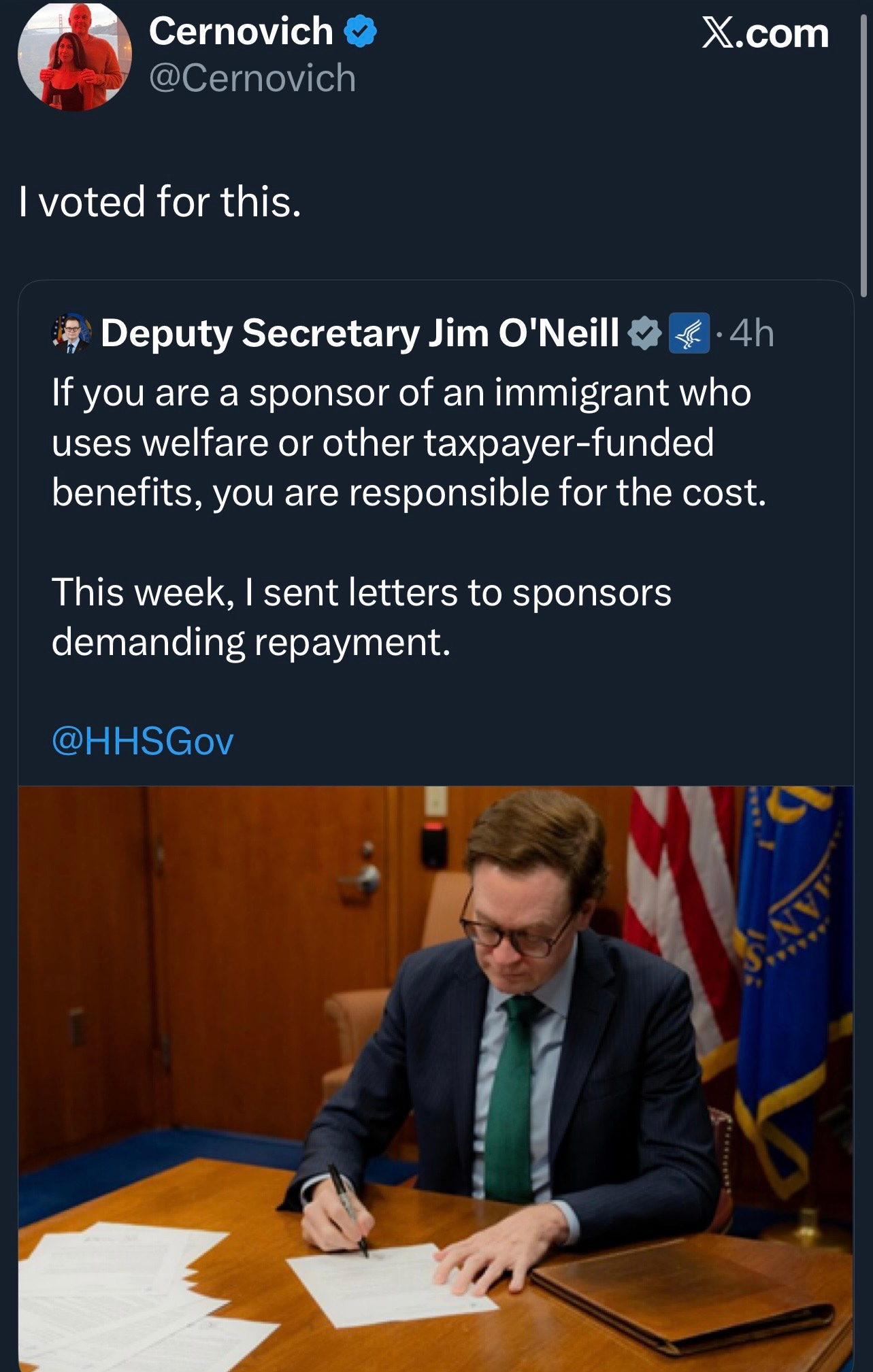
That means temporary bans from high-risk regions. It means aggressive deportation of those here illegally. It means ending the welfare magnet. It means restoring an immigration system that prioritizes contribution, not compassion theater.
France, Germany, the United Kingdom, Canada, and Australia are all hovering at dangerous inflection points, and in some cases it may already be too late.
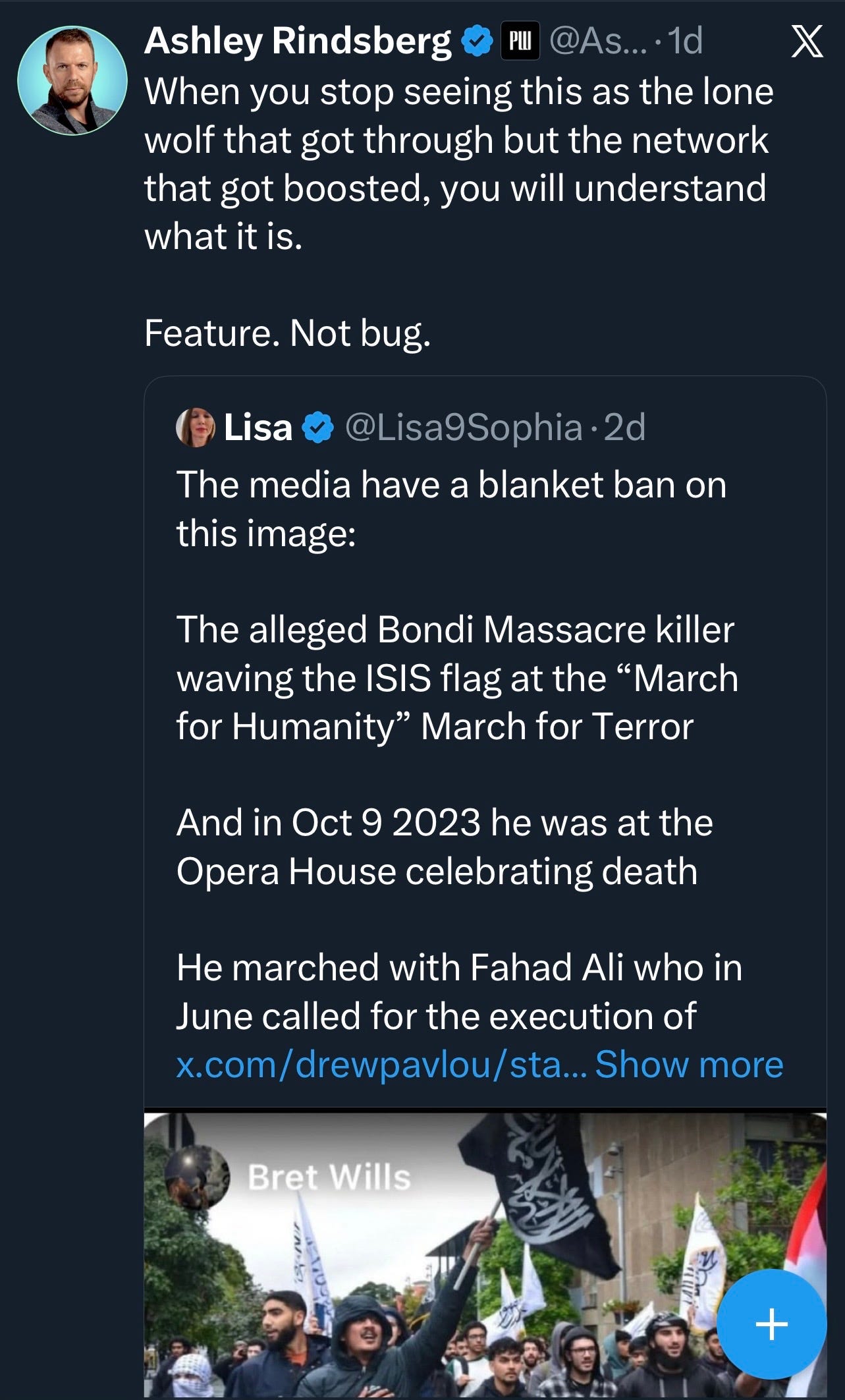
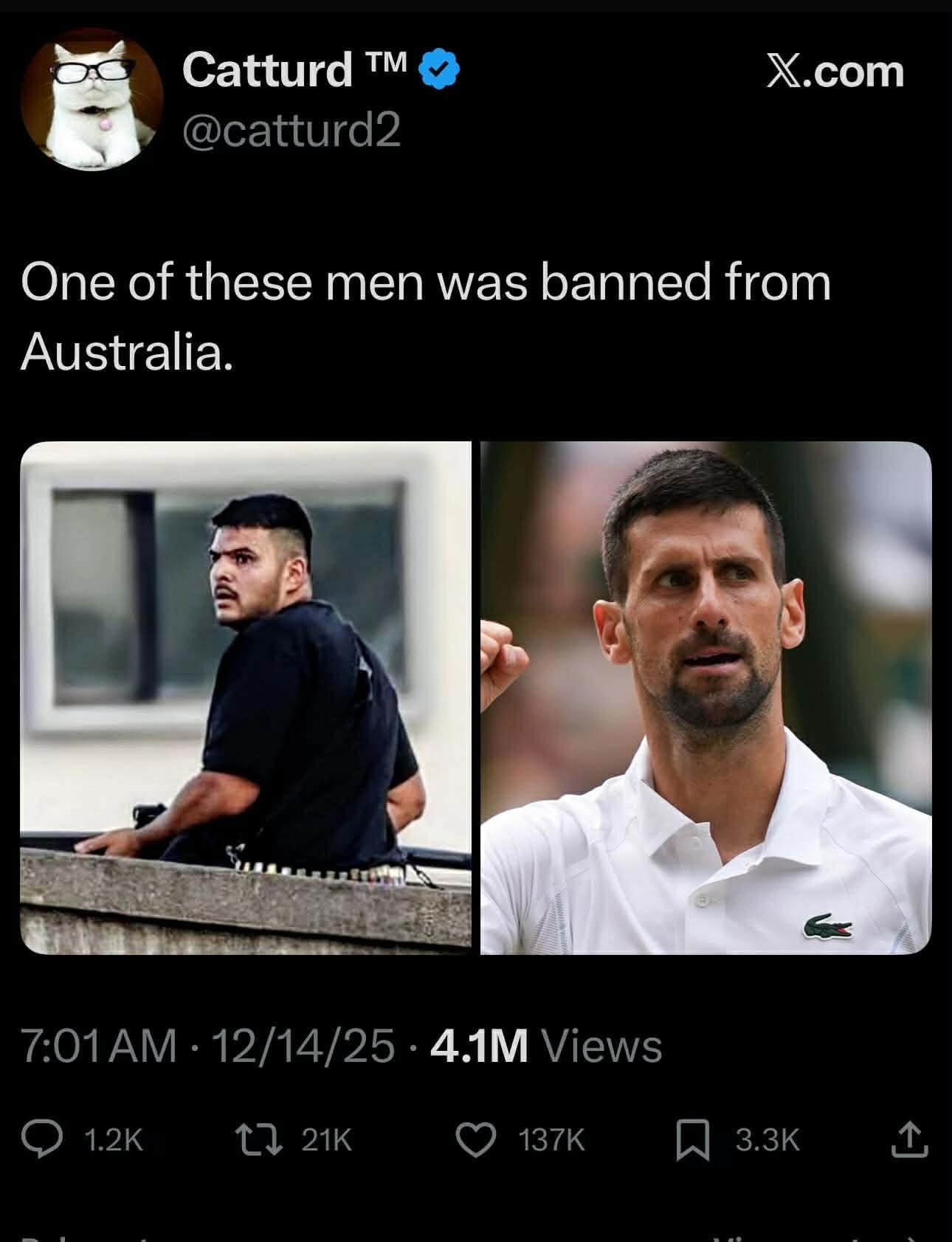
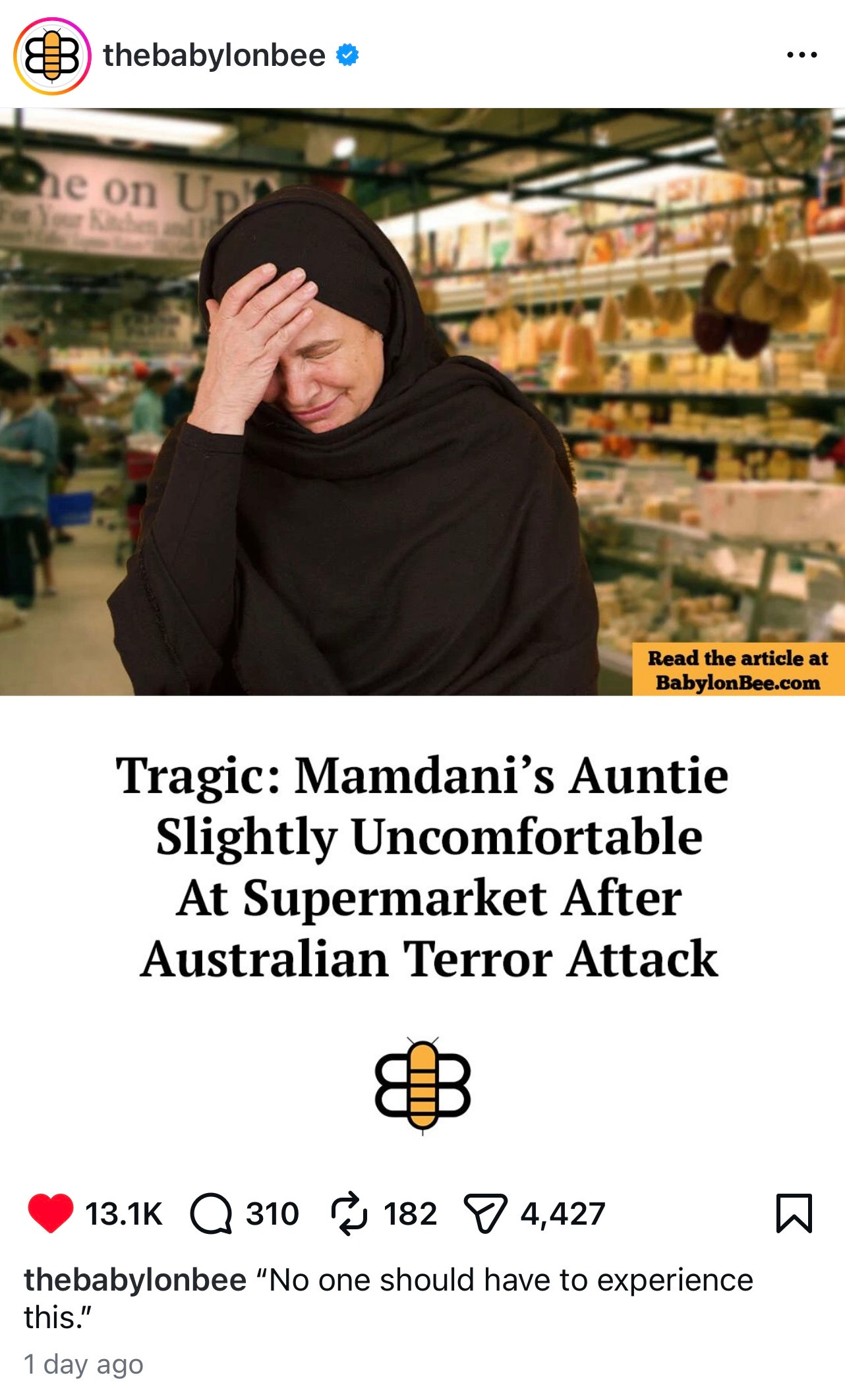
Australia exemplifies denial: On December 14, two gunmen (a father-son duo) slaughtered 15 at a Bondi Beach Hanukkah gathering, injuring dozens in an antisemitic terror strike.
Prime Minister Anthony Albanese, rather than confront imported jihadism, pathetically blamed guns (in gun-scarce Australia) and “right-wing extremism”— gaslighting at its finest.

IV. Remigration, Reality, and the End of Illusions
The time to act was a decade ago. The second-best time is now.
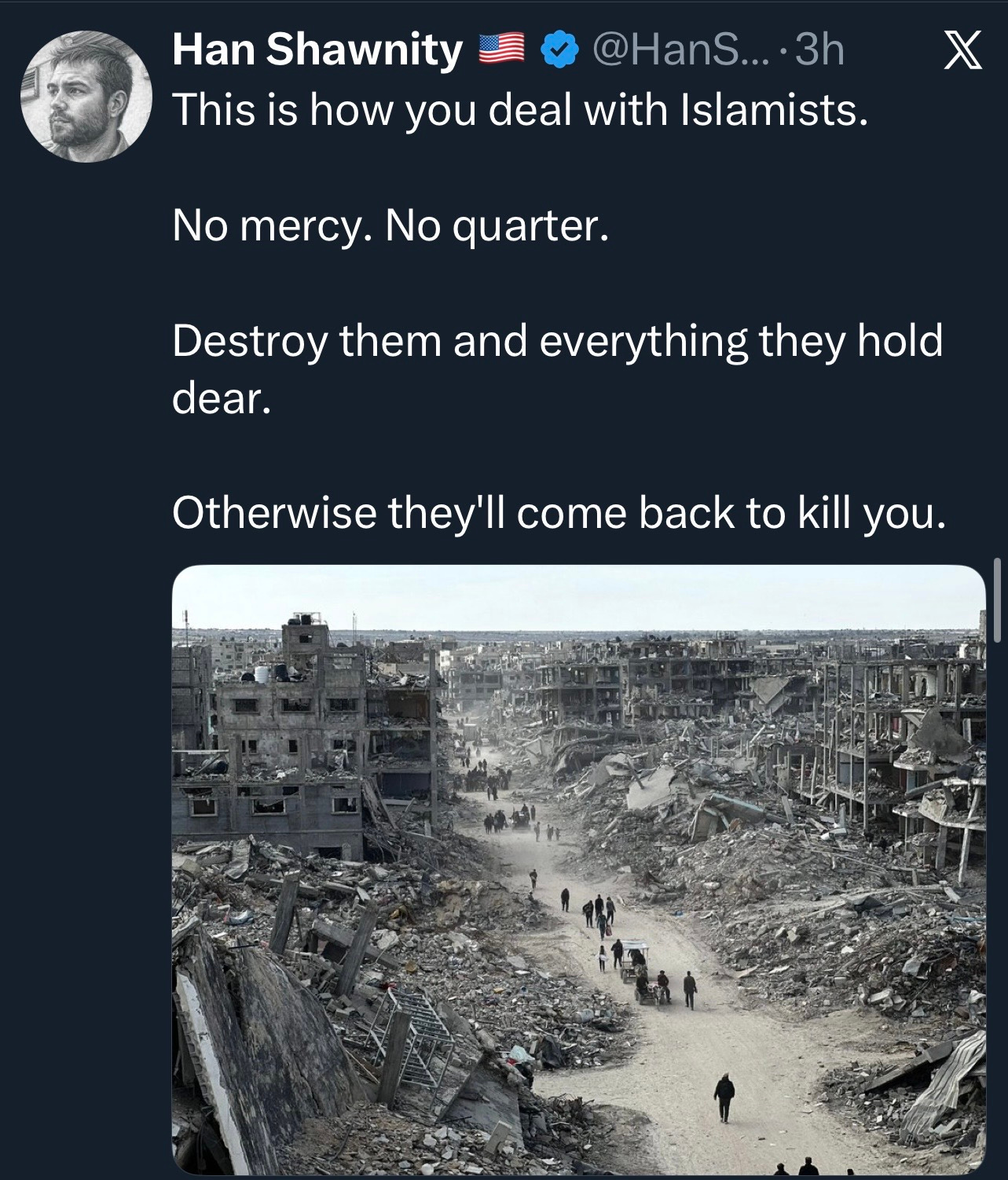
Remigration, voluntary where possible and involuntary where necessary, is the only short-term solution. Incentives matter. Welfare benefits matter. Enforcement matters.
Closer to home, Minnesota’s large Somali enclave has become a case study in failed integration. U.S. Attorney Joe Thompson has pointed to roughly $18 billion flowing through fourteen high-risk public programs since 2018, with a “significant portion” suspected to be fraudulent, what he described as staggering, industrial-scale theft overwhelming the state.
Somalia’s own economy produces roughly $13 billion in GDP from it’s 68 average IQ population. Not surprisingly, the practical outcome in Minnesota has been hard to ignore: persistent fraud, weak integration, and communities that remain heavily dependent on government transfer systems.
High-profile controversies, including long-circulating allegations surrounding figures like Ilhan Omar, have only sharpened public concern. The broader pattern is the point. These arrangements too often produce dependency rather than assimilation, extraction rather than contribution.
The hard truth is this: a decade-long pause on such inflows, paired with a return to a pre–Hart-Celler, merit-based immigration system focused on skills, sponsorship, and self-sufficiency, is overdue. When government programs become the primary interface between newcomers and the nation, they tend to function less as ladders of opportunity and more as vehicles for graft and leverage.
Minnesota offers a case study in institutional rot. Billions in public funds have flowed through programs riddled with fraud. Not incidental fraud. Industrial-scale fraud. Entire systems captured and looted.
This is not compassion. It is corruption.

There is no moral obligation to sustain systems that actively undermine social cohesion, economic stability, and national security. Immigration should be paused long enough for integration to mean something again.
When it resumes, it should resemble a serious, merit-based system. Sponsored. Accountable. No automatic welfare. No entitlement without contribution.
A nation that refuses to draw lines will eventually disappear.
The clock is ticking. Whether we choose to confront reality or continue soothing ourselves with slogans will determine what remains worth conserving.
The fault line is visible now. Let’s not wait for the next flag to become a funeral banner.


The Lost Generation Was Not Lost. It Was Pushed.
Every regime has its disposables.
Every moral panic demands a sacrifice.
In Jacob Savage’s devastating essay “The Lost Generation,” published in Compact, we are finally forced to look squarely at the human cost of America’s ruling class experiments. Not in abstractions. Not in slogans. In careers ended before they began. In doors quietly closed. In a decade of opportunity denied to one very specific cohort: white male millennials.
This was not an accident.
It was not a “market correction.”
And it was certainly not justice.
Savage’s reporting reads less like social commentary and more like an autopsy. The patient is meritocracy. The cause of death is ideological capture.
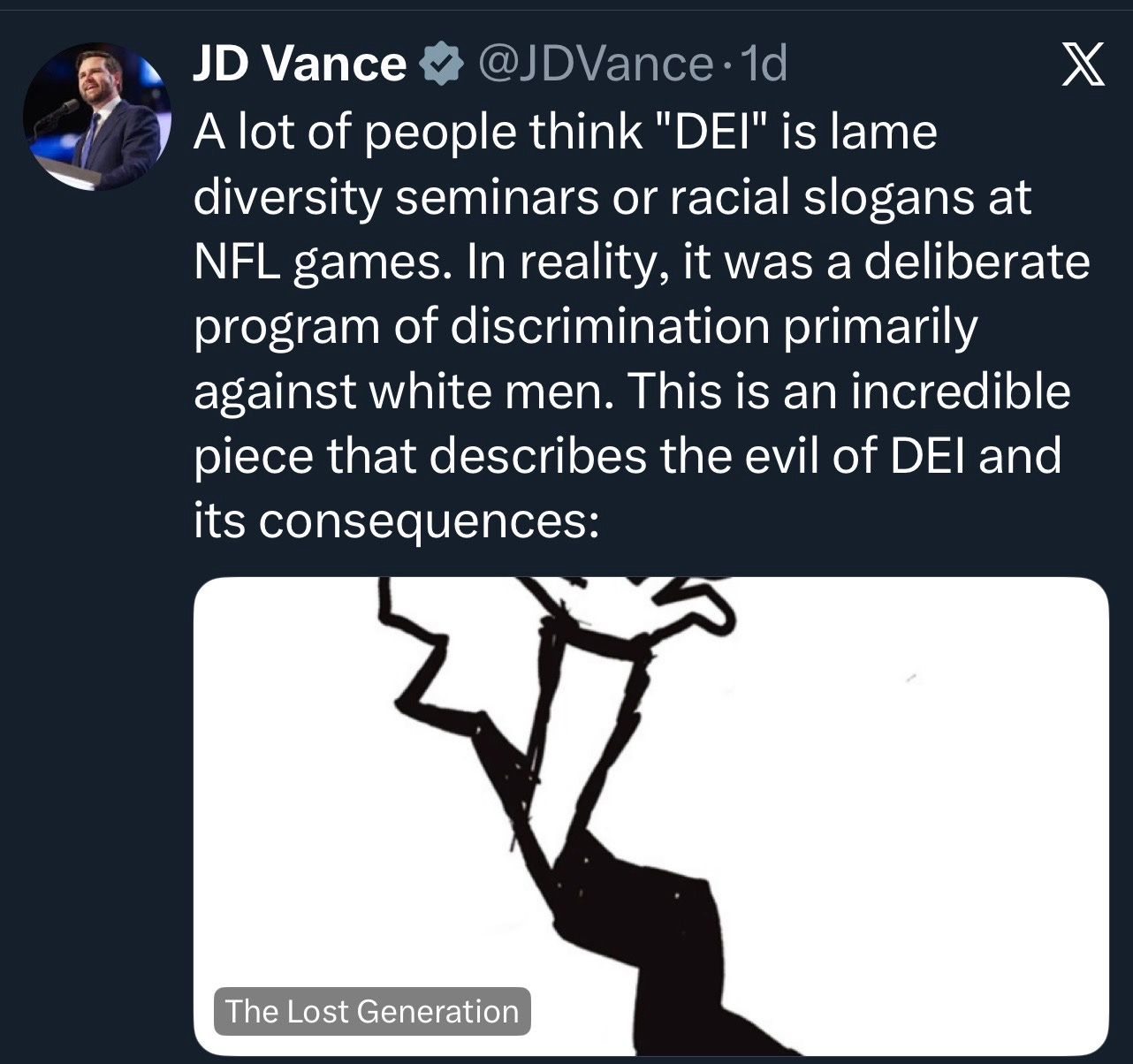
Beginning aggressively around 2014 (with roots spouting back in the 90s), and accelerating sharply after 2020, elite American institutions made a collective decision. They would cleanse themselves of “excess whiteness” and “maleness,” regardless of individual merit, talent, or effort. The moral justification was diversity. The operational reality was exclusion.
Savage opens with a moment that will feel painfully familiar to thousands of men who came of age during this era. In 2016, he was on the brink of a Hollywood writing job when the offer evaporated. The reason was not quality. It was optics. An all-white-male writers’ room was unacceptable. The decision was not debated. It was enforced.
That moment was not unique. It was emblematic.
Across television, white men once made up nearly half of lower-level writing positions. Today they hover just above ten percent. At The Atlantic, editorial staff went from overwhelmingly white and male to dramatically reengineered in less than a decade. Harvard’s humanities departments quietly halved the presence of white men on the tenure track. Yale and Berkeley followed the same path, with hiring collapses that cannot be explained by chance or merit.
These are not trends. They are patterns.
And the cruel irony is this: the architects of this purge were often older white men themselves, safely ensconced in senior roles. They survived. They complied. And then they pulled the ladder up behind them.
Millennials were the collision generation. Born too late to establish power before the DEI regime hardened, and too early to benefit from the moral exemptions now handed out to favored groups, they hit a wall precisely when careers are meant to take off. They did what they were told. They studied. They worked. They waited their turn. And then they were told their turn would never come.
In journalism, Savage documents how post-2014 rhetoric about “white male dominance” metastasized into obsessive demographic engineering. Hiring meetings revolved around checklists, not competence. Managers spoke openly about having “enough white guys already.” Promotions stalled. External recruits leapfrogged internal talent to satisfy quotas. A generation of capable reporters was quietly sidelined.
Academia was worse. Assistant professorships, once brutally competitive but theoretically fair, became gated by identity. When white men were hired, they were often foreign-born, older, or statistical outliers. The American millennial male was the least welcome category in the very institutions his taxes and tuition sustained.
Then came 2020.
George Floyd’s murder and the subsequent riots did not introduce DEI. They weaponized it. What had been bureaucratic bias hardened into moral absolutism. Newsrooms conducted “reckonings.” Universities pledged permanent racial rebalancing. Corporate America followed suit. Opposition was not debated. It was pathologized.
Internships, the lifeblood of professional entry, became exclusion zones. At major newspapers, white male representation dropped into the single digits. Fellowship programs replaced internships precisely because fellowships could be more easily curated. Publishing houses openly avoided narratives centered on white male experience. A class of writers simply vanished from the pipeline.
This was not inclusion.
It was elimination.
And it violated the most basic American promise.
The Fourteenth Amendment does not say “equal protection, except when fashionable.” It does not permit racial balancing, sex-based exclusion, or collective punishment. Its purpose was to end discrimination, not reverse its direction. Yet America’s most powerful institutions have spent a decade doing exactly that, cloaking racial sorting in therapeutic language and moral posturing.
What we are witnessing is not progress. It is revenge politics. It is a politics that confuses justice with punishment and equity with outcome engineering. And it has left a generation stranded.
The Trump administration’s dismantling of DEI bureaucracies is not radical. It is corrective. But it is not sufficient. What Savage’s essay ultimately demands is something deeper and more uncomfortable: a return to first principles.
Merit must matter again.
Fairness must apply to everyone.
And no group, however unfashionable, can be designated as society’s permanent villain without tearing the country apart.
White male millennials did not cause America’s sins. They inherited them. And they paid for them anyway.
They are not lost.
They were pushed aside.
The question now is whether the country that sidelined them is capable of welcoming them back. Not as a special class. Not as victims. But as equal citizens once again, judged by what they can do rather than who they are.
That is not nostalgia.
It is the only path forward.
And if we refuse it, we will discover that a nation willing to discard its sons will eventually find itself without a future at all.
But recognition alone is not enough.
Confession without consequence is how institutions launder guilt and move on unchanged. America does not restore justice by issuing apologies, publishing diversity reports, or quietly “sunsetting” failed programs. Justice requires accountability. It requires punishment. It requires atonement.
The discrimination Savage documents was not rhetorical. It was operational. It was systematic. And in many cases, it was illegal.
For government actors and publicly funded institutions, the Equal Protection Clause of the Fourteenth Amendment is unambiguous. Race- and sex-based discrimination in hiring, promotion, internships, and fellowships is forbidden absent the narrowest constitutional scrutiny. For private employers, Title VII of the Civil Rights Act of 1964 draws the same bright line. You may not hire, fire, promote, or exclude on the basis of race or sex. Not even for fashionable reasons. Not even in the name of “equity.”
For more than a decade, elite institutions violated these principles openly, repeatedly, and often brazenly. They kept spreadsheets. They set targets. They circulated internal memos. They told qualified candidates, sometimes explicitly, that their identity disqualified them. That is not accidental bias. That is evidence.
And evidence demands enforcement.
The Civil Rights Division of the Department of Justice should not merely “review” these practices. It should investigate them mercilessly. Subpoena records. Depose executives. Trace hiring pipelines. Expose the machinery. Where discrimination is proven, penalties should be crushing. Not symbolic fines. Not press releases. Real consequences. Multimillion- and billion-dollar judgments that make clear this era was not a harmless detour but a civil rights abomination.
Nor should enforcement stop at the government’s door.
Those who were excluded, stalled, or denied opportunity because of race or sex should organize, litigate, and sue. Class actions where possible. Individual suits where necessary. Discovery alone will do more to cleanse these institutions than a thousand DEI task forces ever did. Some firms deserve reform. Others deserve oblivion. That is how deterrence works.
This is not vengeance. It is restoration.
A society that tolerates open discrimination against one group will eventually tolerate it against all groups. The law does not exist to flatter elites or validate moral fads. It exists to restrain power and protect citizens equally. When institutions violate that compact, they forfeit moral authority and invite judgment.
White male millennials did not ask for special treatment. They asked for the rules they were promised. They followed them. And they were punished anyway.
If America is serious about equality, it must prove it not with slogans, but with verdicts. Not with acknowledgments, but with accountability. Not with symbolic gestures, but with consequences severe enough to ensure this never happens again.
Only then does merit mean something.
Only then does equal protection become real.
And only then can a generation that was pushed aside finally step back into a country that remembers what justice is for.
Best of Twitter




Memetic Warfare









Parting Words….


That’s it for this week folks. Hope you enjoyed!
Each week, Sovereign Sunday delivers battle-tested truths, bold analysis, and civilization-defending commentary you won’t find in legacy media echo chambers. No algorithms. No gatekeepers. Just raw signal in a world drowning in noise.
If this newsletter sharpens your mind, steels your spirit, or gives you ammo for the cultural battlefield—do your part:
Smash the like/heart button! (it helps us beat the bots).
Forward to friends, family, fellow patriots—anyone who’s tired of lies wrapped in politeness.
Leave me a comment
Become a Paid Subscriber and fuel the mission. This isn’t a hobby—it’s a war for the narrative. And we’re building an army of the awake.
This is reader-supported, freedom-fueled journalism. Your support makes it possible.
—Michael Kimelman
Founder, Sovereign Sunday
I don't expect the Justice Department to do much. It's run by a white girl that went after George Zimmerman in 2015.
Happy Hanukkah and Merry Christmas, Mike. God bless.