
Moral Inversion

The Inversion
There is a particular kind of collapse that does not arrive all at once.
It comes the way rot finds old wood. Not with a crack or a crash, but through patient, invisible work, until the thing that looked solid turns to dust under the faintest pressure. Call it what it is: inversion. The slow, almost imperceptible process by which a man’s convictions flip like a coin in the air, until the person who once mapped the threat is now insisting there was never a map, never a threat, never anything worth worrying about at all.

History is full of such figures. The anti-war hawk who discovers peace is more profitable than principle. The populist reformer who gets close enough to power to smell it and decides, quietly, that the system wasn’t so bad after all. The whistleblower who turns out to have been blowing in whichever direction the wind pays best. We recognize the type. We just rarely catch them mid-flip.
With Joe Kent, we caught him mid-flip.
The tell, when it came, was not conviction. It was not courage. It was not even ideology.
It was opportunism, dressed as always in the borrowed clothes of enlightenment.
Joe Kent, until recently the Director of the National Counterterrorism Center and, before that, a man whose primary public distinction was losing a reliably red congressional seat in Washington State twice to the same unspectacular Democratic opponent, did not resign in protest. He retreated under pressure.
That distinction is not semantic; it is everything. Protest requires a principle to defend. Retreat requires only an exit. And the fact that a man who could not hold a safe Republican House seat was subsequently confirmed to lead the nation’s premier counterterrorism apparatus tells you something about the credentialing process in the current environment, even before we get to what he did next.
Because what followed his exit was not a defense of anything so much as a surgical demolition of his own record: a reversal so complete, so convenient, so perfectly timed to the incentives of a particular media ecosystem, that it strains every honest reading of events.
People did what the performance class always hopes they won’t do.
They checked receipts.
They pulled the tape Warner Wolf style. Not vague impressions or secondhand summaries, but actual statements, on the record, in Kent’s own voice.
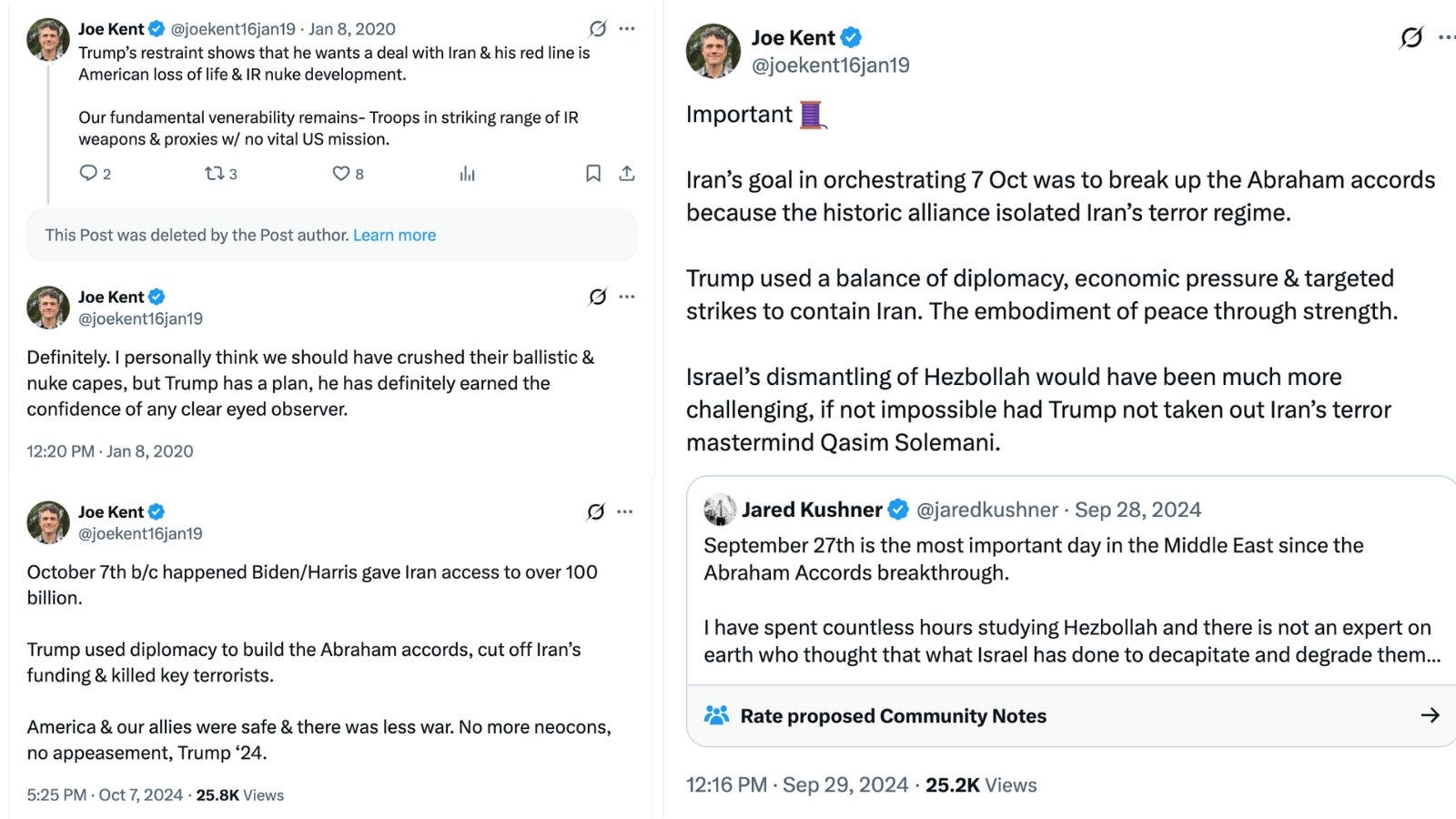
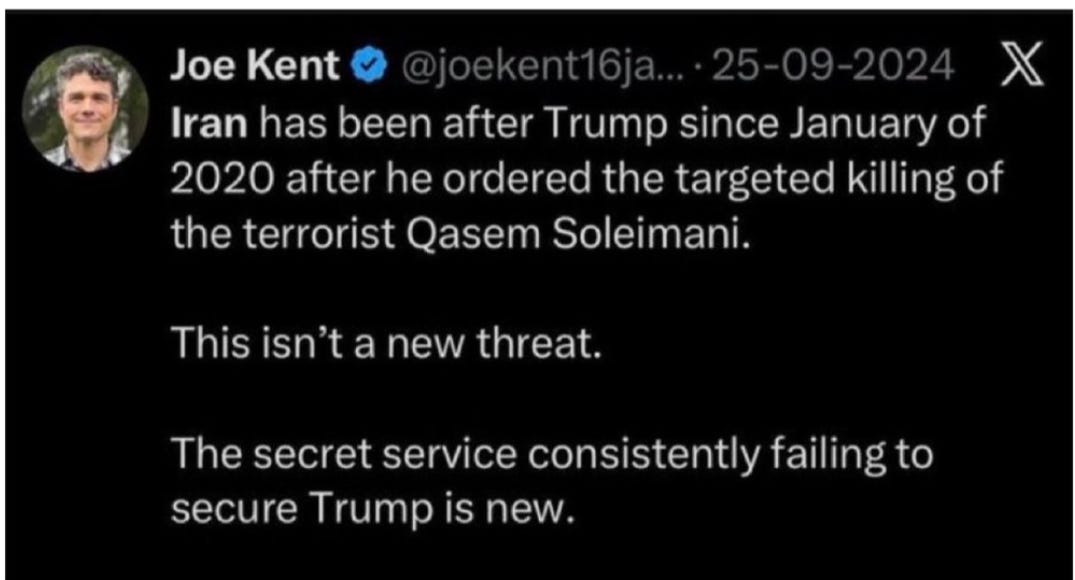
His congressional testimony describing Iran and its proxies as the most significant state-backed terror threat facing the United States.
His interviews walking through the regime’s nuclear trajectory with the clinical specificity of someone who had actually looked at the intelligence.
His appearances, including extended conversations on Shawn Ryan’s show, where he described Hezbollah, Hamas, and the full operational reach of the Iranian network with zero ambiguity.

He was not hedging. He was not qualifying. He spoke about proxy warfare, about intelligence signals, about the necessity of sustained pressure to prevent catastrophic escalation. He spoke like a man who believed what he was saying.


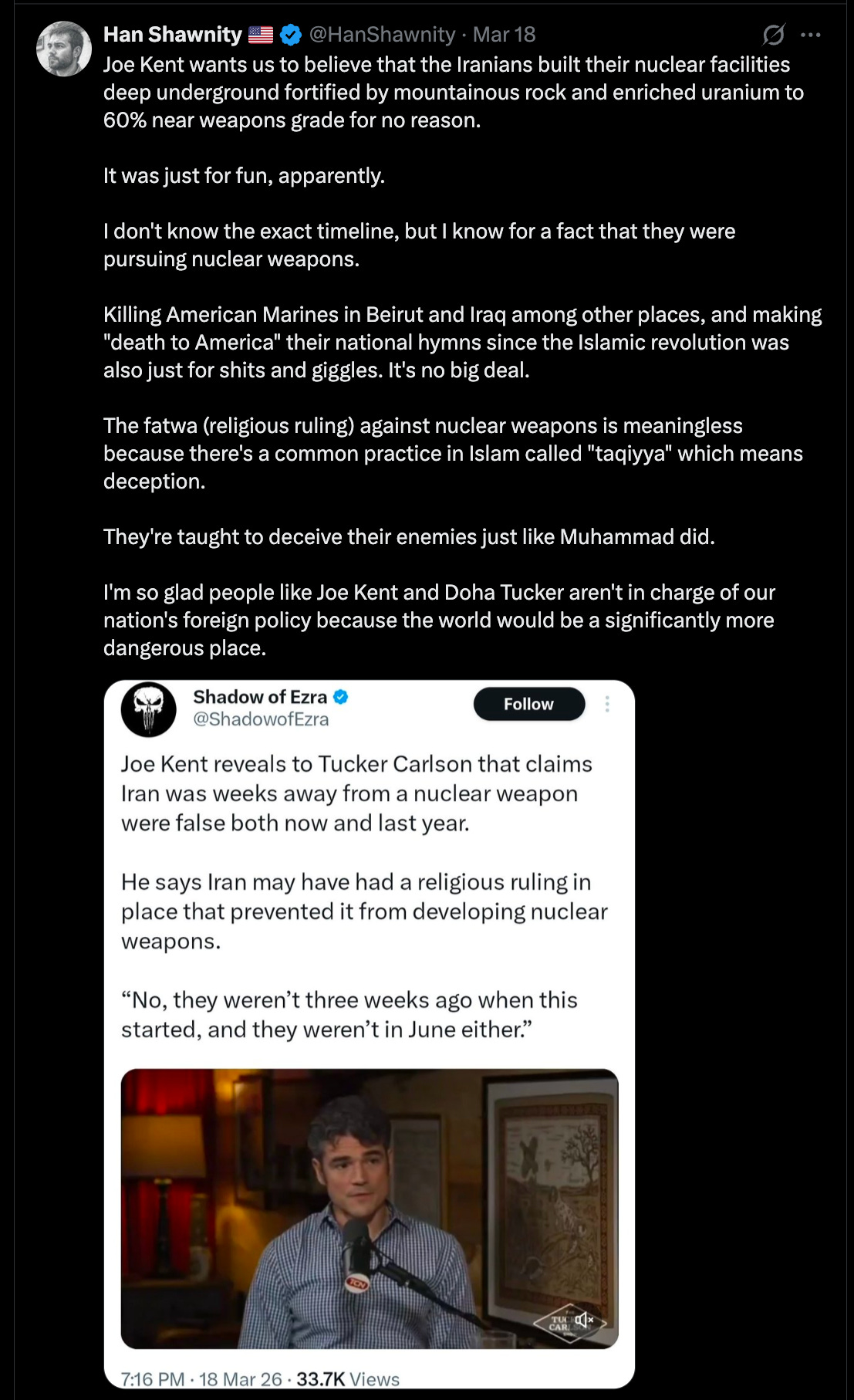
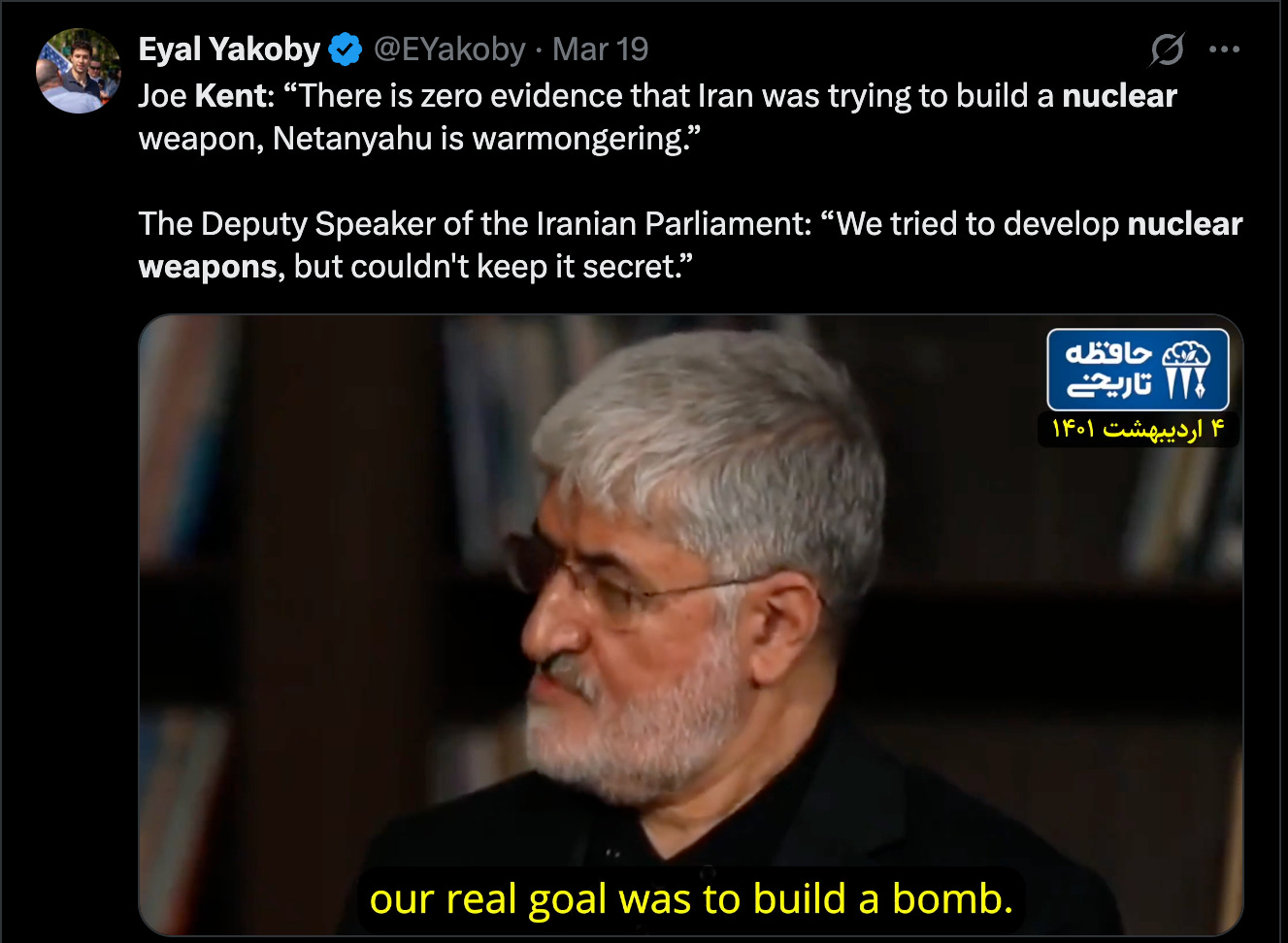
That was not ancient history. That was recent.
They found his warnings about Iranian enrichment levels that exceed any plausible civilian purpose, his own words describing a trajectory with one destination. They found his analysis of the exact networks he now waves away as overblown.
Then they placed those statements side by side with his resignation letter and subsequent media tour.
The contrast was not subtle. It was not a matter of interpretation or nuance or evolving assessments in light of new evidence. It was the difference between a man who mapped a minefield and a man who now insists there were never any mines. The man who understood strategic stakes had become the man who reduced them to manipulation by unnamed, conveniently unspecifiable forces.
Pause on that phrase: unnamed forces. Because in the ecosystem Kent was now performing for, “unnamed” is doing a great deal of work. It is a wink. An ellipsis where a slur used to go. The architecture of insinuation that the internet has refined into something almost algorithmic: you don’t have to say the Jews when your audience already knows who you mean, when the comment section will fill in the blank for you, when the Telegram channels and the X replies will complete the thought you carefully left unfinished. The scapegoat does not need to be named. It needs only to be implied, and then the machine does the rest.
This is not evolution. Evolution requires new information. This required only new incentives. But for those wondering when, precisely, the transformation began, and what specifically was doing the transforming, there is an answer more concrete than abstract incentive structures.
Kent’s reversal did not happen in a vacuum. It tracked, with notable fidelity, the arc of his personal life. His second wife, Heather Kaiser, is a writer for The Grayzone, the outlet founded and run by radical self-hating Jew Max Blumenthal, one of the most compulsively anti-American and anti-Israel voices in American media and a self-described Jewish radical who has spent his career platforming every conceivable conspiracy against Israel, the West, and the intelligence architecture Kent once served. The Grayzone is not a heterodox outlet asking hard questions in good faith. It is a publication whose output has been cited approvingly by Russian state media, Venezuelan government officials, and Iranian propaganda channels with a regularity that ceased to be coincidental some time ago.
The ancient observation holds, from Eve to Delilah, that there is no more reliable Achilles’ heel for a man of action than a corrupting intimate influence. Kent entered that marriage as a Gold Star husband, a decorated Green Beret, and a counterterrorism official on record describing Iran as an existential threat. He emerged from it as something considerably harder to classify: a man whose foreign policy instincts now echo, with uncomfortable precision, the positions of the very regimes he once hunted. Whether Kaiser’s influence was deliberate, ambient, or simply the natural result of spending one’s domestic life marinating in Grayzone editorial meetings is a question only Kent can answer. What is observable, from the outside, is the timing. And the timing is not subtle.
That is not evolution. It is not even persuasion. It is a man who stopped being shaped by the intelligence he consumed professionally and started being shaped by the ideological water he swam in personally. The Green Beret became the mouthpiece. The counterterrorism chief became the useful vessel. And the transformation was complete enough, and convenient enough, that the only remaining question is whether Kent understands what happened to him, or whether he is still too invested in the narrative of his own courage to look clearly at the mechanism of his own capture.
The response from serious corners of the right reflected exactly that understanding.
Analysts, lawyers, policy voices and even the more irreverent but grounded commentators did not treat Kent as a whistleblower. They treated him as a case study in what happens when the reward for a convenient reversal outweighs the cost of intellectual consistency.
They also noted something structurally important: Kent was not in the room.
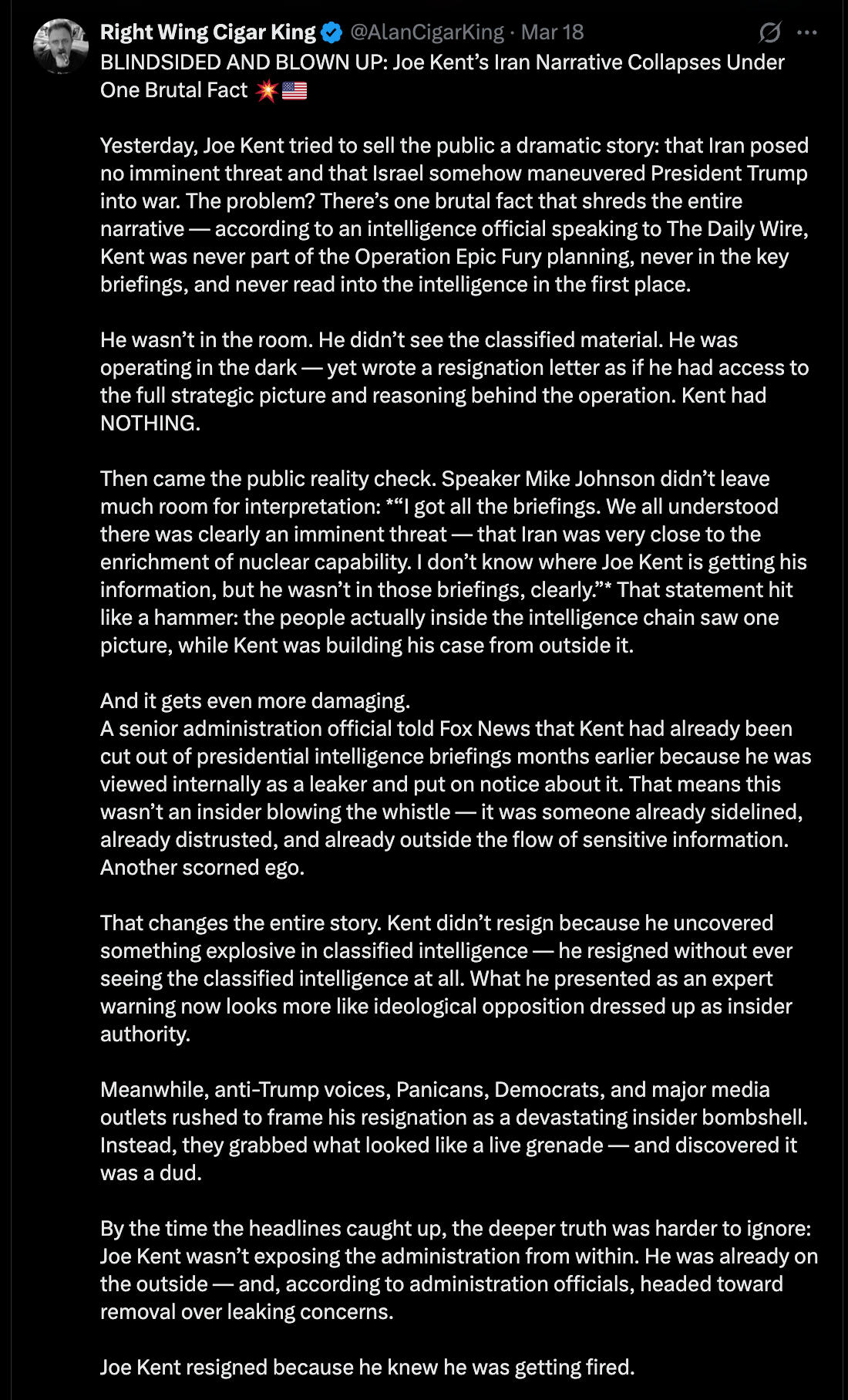
By the time he began making claims about the state of American intelligence, he had been sidelined from it. He was not read into the sensitive briefings shaping decision-making at the highest levels. The people who were, including senior leadership with access to a far more granular picture of Iran’s current posture and trajectory, were operating with information Kent demonstrably did not have. Which means this was not a courageous insider exposing hidden truths. It was a sidelined operator presenting incomplete information as definitive, while simultaneously disowning the conclusions his own prior analysis had reached.
Timing, as always, tells you the rest.
Because there is an entire ecosystem waiting to reward exactly this kind of pivot.
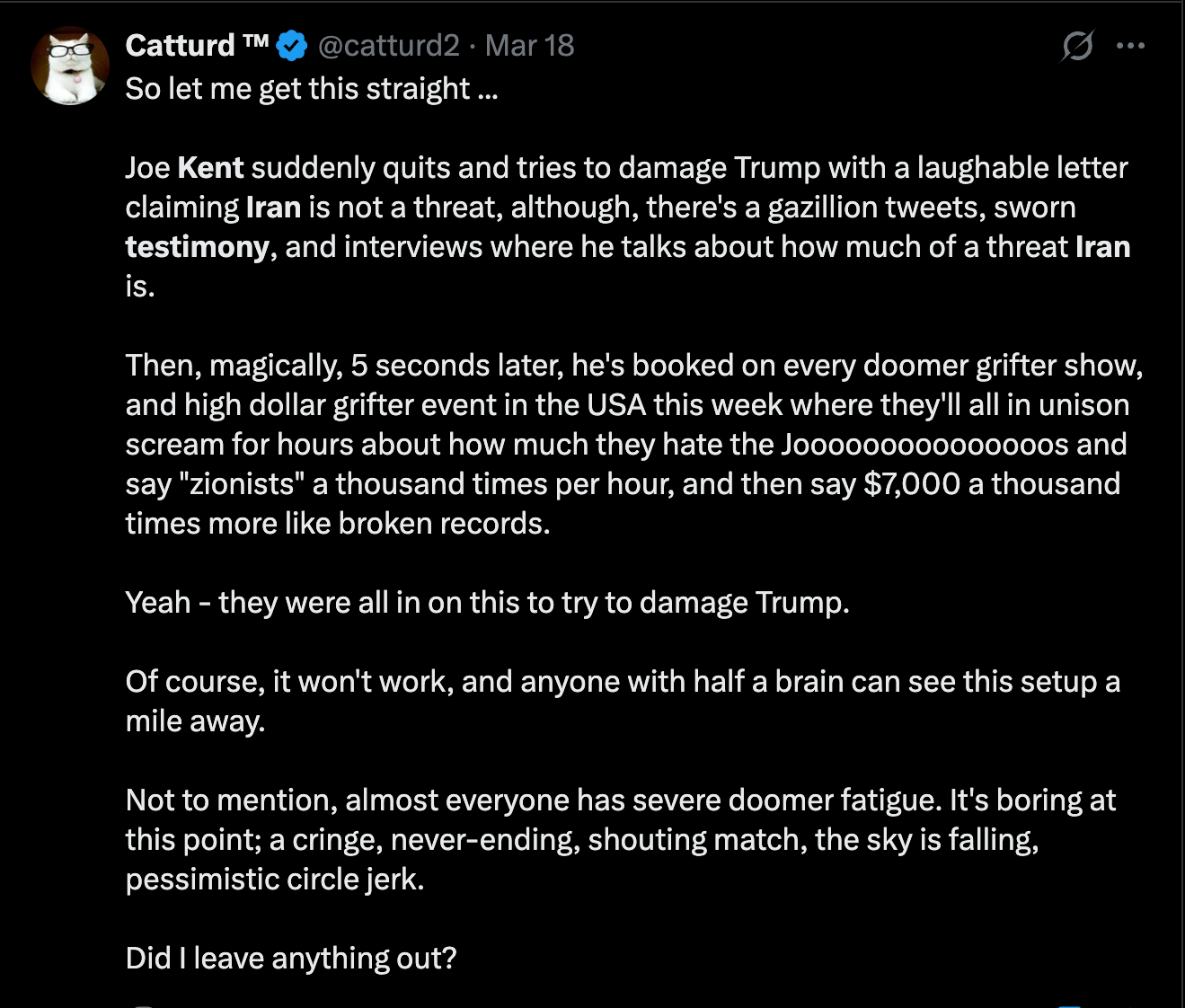
Call it the panic industry. Call it the grift economy. Call it the performance wing of a movement that discovered, some time ago, that there is far more money in outrage than in accuracy, far more clicks in narrative than in evidence, and far more followers in telling people their enemies are imaginary than in explaining why those enemies are real and dangerous.
The playbook is now unmistakable: take legitimate grievances about foreign entanglements and failed interventions, and there are legitimate ones, then launder them into a worldview that replaces strategy with reflex. Reduce geopolitical complexity to a single talking point. Replace adversaries with abstractions. Replace evidence with insinuation. And when arguments cannot be won on facts or principles, when the evidence refuses to cooperate and the logic collapses under scrutiny, reach for the oldest tool in the demagogue’s kit: the scapegoat.
Not just any scapegoat. The scapegoat. The one that has served this function for two thousand years with such reliability that it has become, at this point, less an argument than a reflex. It’s da Joos, the online generation’s abbreviation for a libel so ancient it predates the printing press, so durable it survived the Enlightenment, so adaptable it has attached itself to every failing political movement from medieval peasant revolts to twentieth-century fascism, always offering the same service: a face to put on forces too complex to honestly explain, a villain whose guilt requires no evidence because the accusation itself is the point.
The blood libel, the medieval claim that Jews murdered Christian children for ritual purposes, was never really about children. It was about power. Specifically, about what happens when a community without power is handed to a mob that needs someone to blame for its misery. The specific charge changed with the centuries. Jews poisoned the wells. Jews controlled the banks. Jews started the wars. Jews run the media. Jews coordinate the globalists. The content updated; the structure did not. Always the hidden hand. Always the shadow network. Always the unnamed forces, pulling strings just offscreen, responsible for everything, accountable to no one.
What is new, in our moment, is the business model.
The attention economy has done something genuinely novel: it has made antisemitism profitable at scale, in real time, with a measurable return on investment. A video blaming Jewish influence for some policy outcome does not merely reach its intended audience; it gets boosted, clipped, quoted, ratio’d into virality. The outrage of the people it offends drives the algorithm as effectively as the approval of the people it attracts. And layered beneath the organic dynamics, amplifying everything, are state actors for whom this content is a strategic asset: Russian influence operations that have been documented seeding and boosting anti-Israel, anti-Jewish narratives across Western platforms; Chinese actors gaming algorithmic systems to deepen social fracture; Islamist networks, Iranian-backed, Qatari-funded, ideologically committed, that have discovered the American attention economy is not merely an audience but a weapon, available for use against the civilization it belongs to.
They are not subtle about it. Iranian state media openly reposts American influencers making their case for them.
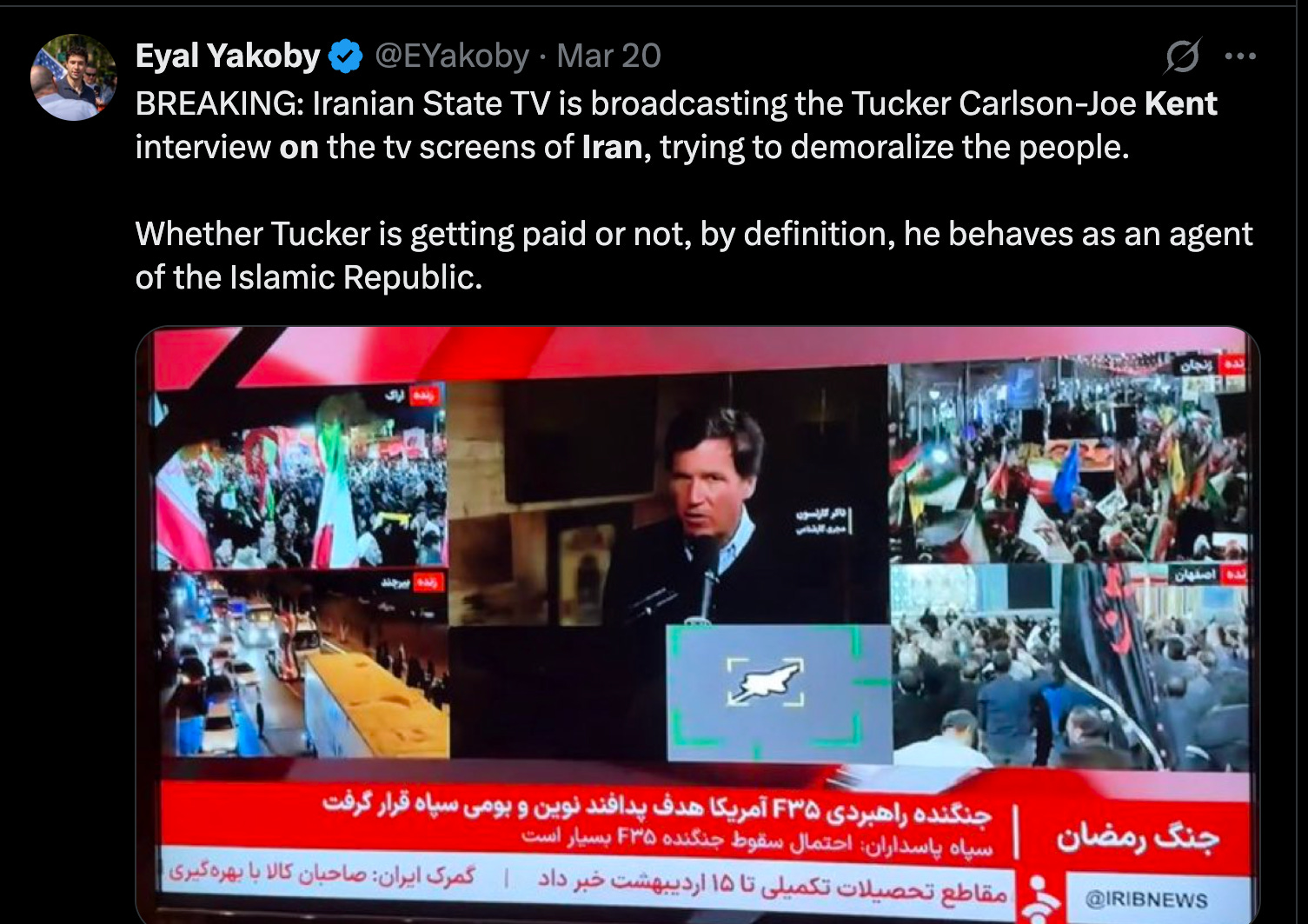
Russian bot networks, identified and documented by the Stanford Internet Observatory and others, have specifically targeted Jewish-adjacent political narratives as high-value fracture points. The perpetrators of the oldest slander on earth have found that in the attention economy, curses generate clicks, and there are foreign treasuries willing to subsidize the cursing.

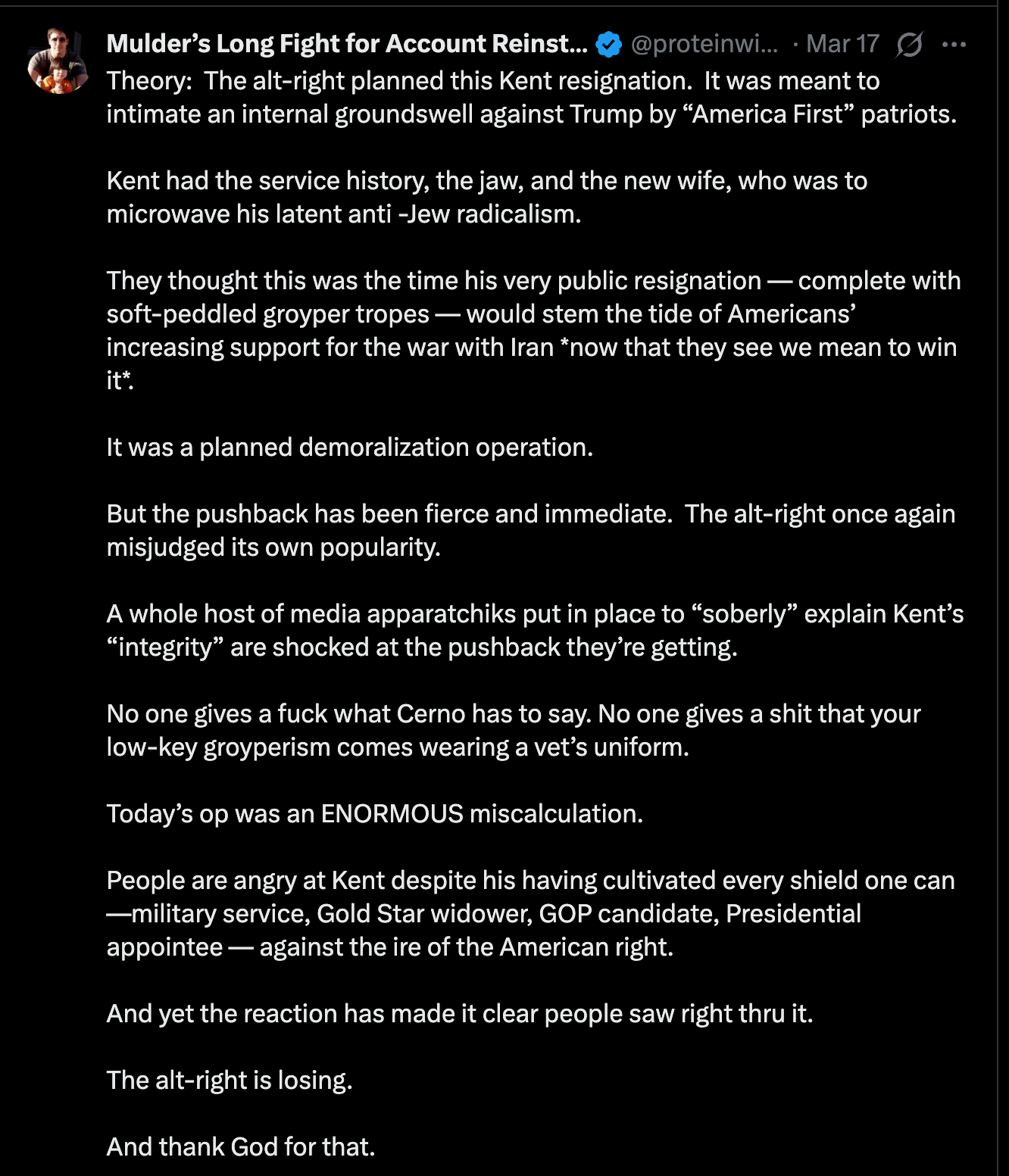
The algorithm rewards. The bots amplify. And the grifter who found that “unnamed forces” moves units does not need to understand any of this to participate in it. He only needs to know what the data shows: that this particular insinuation, in this particular moment, is monetizable. That the audience is ready. That the comment section will provide the specificity he carefully withheld.
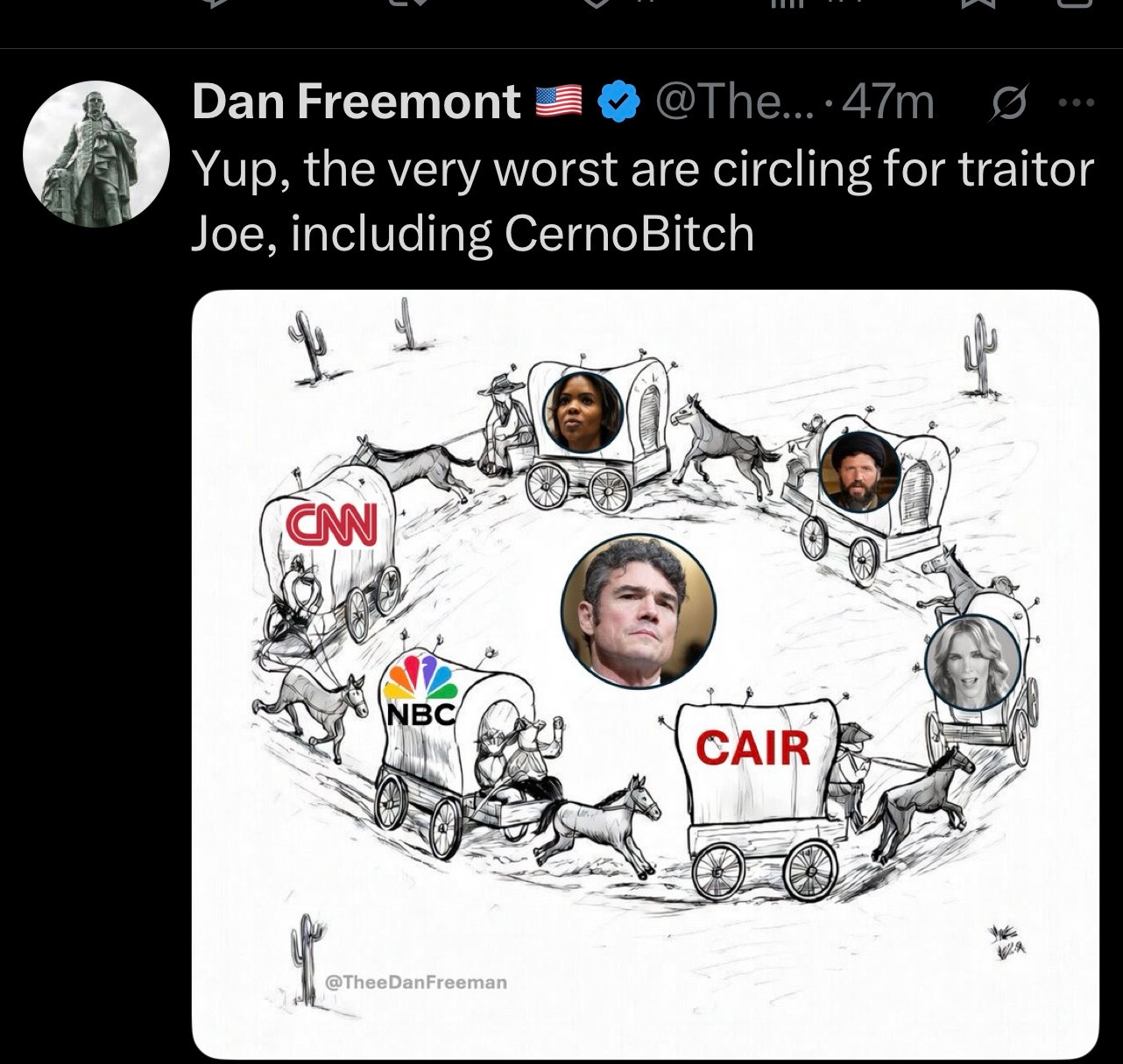
And while Kent was busy curating his exit narrative, the actual job sat neglected.
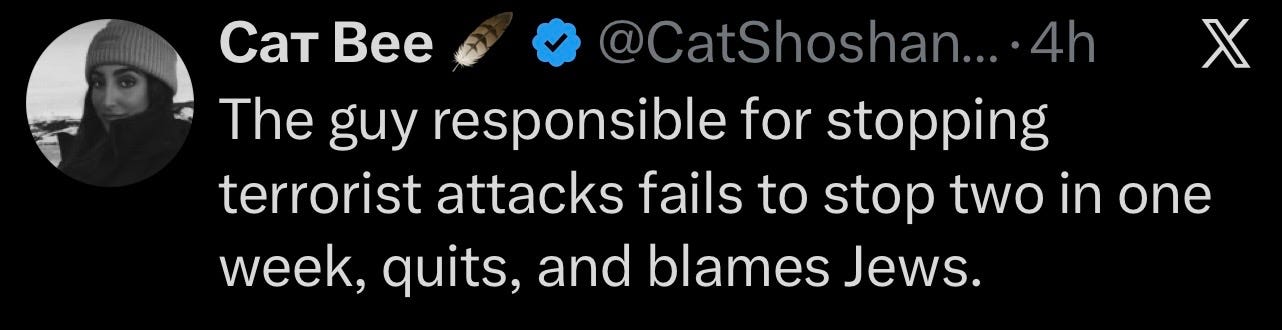
This is the part that should sting every serious conservative, because it is not abstract. We are living through a documented surge of domestic left-wing and Islamist political violence: Jihadist mass shootings, Antifa firebombings, red-green alliance plots, campus radicals and their Muslim Brotherhood fellow travelers turning public spaces into functional no-go zones for conservatives and Jews alike. These are not hypothetical threat assessments or think-tank projections. They are daily verifiable realities, with attack records, funding trails, and coordination networks visible enough that any competent counterterrorism director with access to the full apparatus of American intelligence should have been mapping, dismantling, defunding, and referring for prosecution.
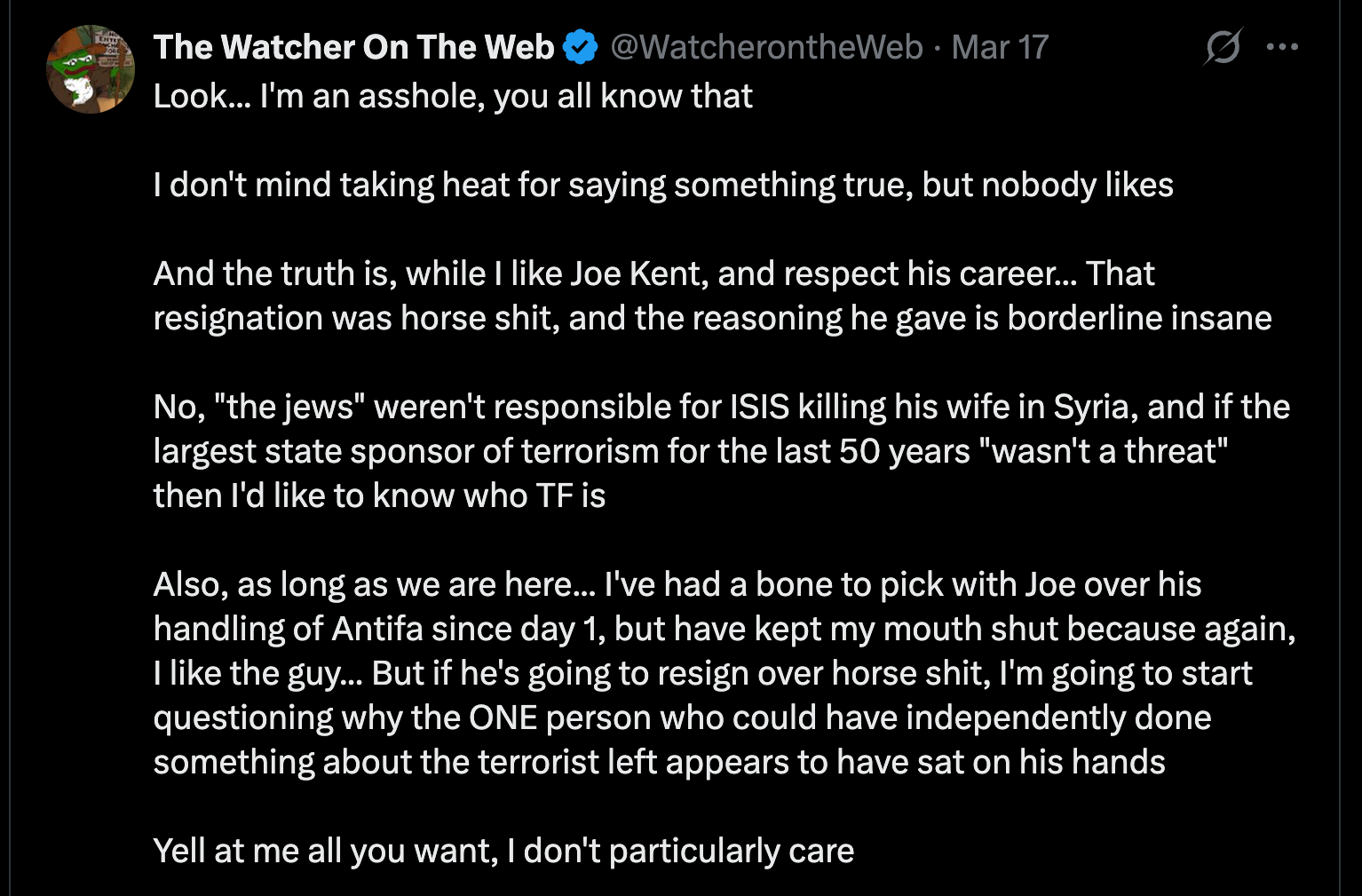
Instead, the man in charge of that apparatus was, by all available evidence, more absorbed in Candace Owens loony toon podcasts and pre-resignation media strategy than in the portfolio he was confirmed to execute.

The National Counterterrorism Center exists for one purpose: to integrate intelligence and prevent attacks on American soil and American interests. Kent had the title, the clearances, the institutional infrastructure, and the mandate. What he apparently lacked was the interest, at least in the threats that did not serve his emerging post-resignation narrative.
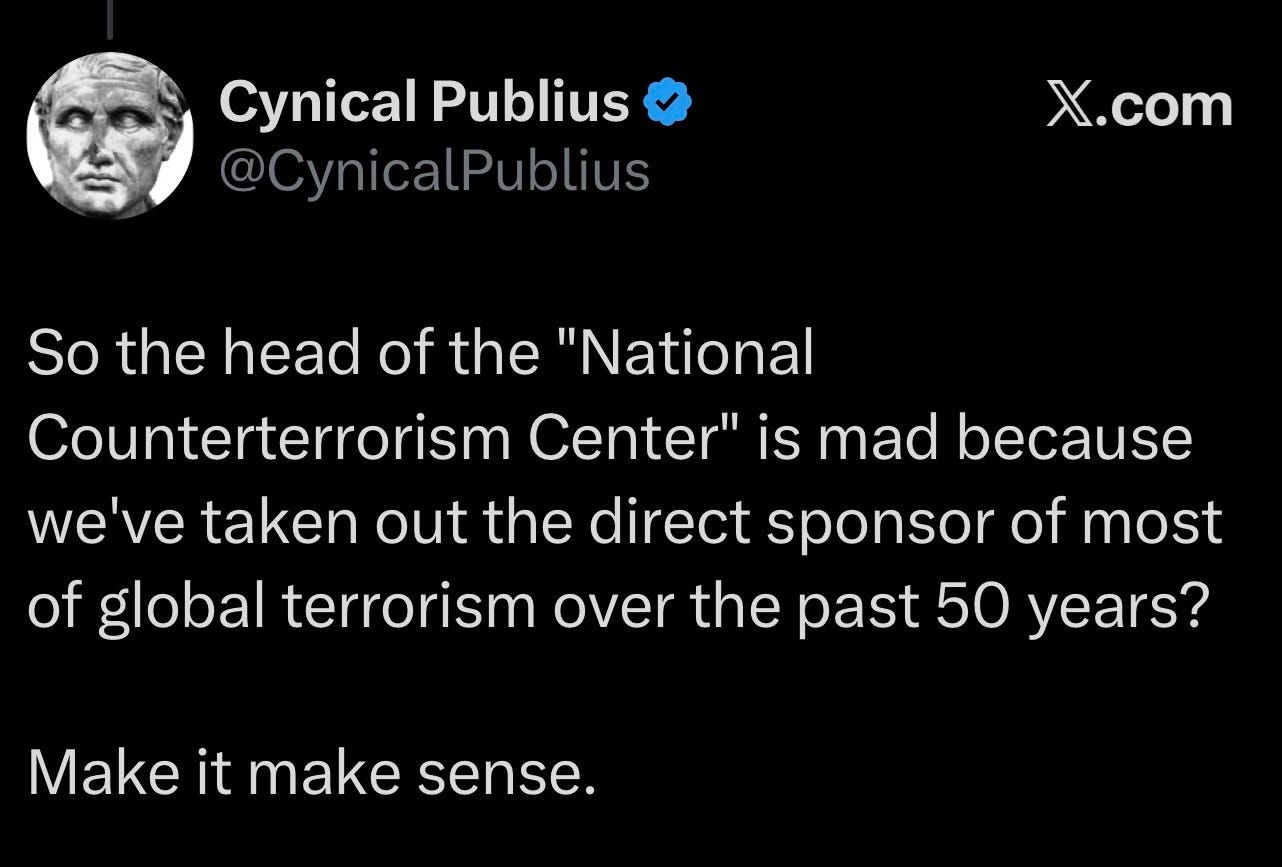
The irony is almost too neat to be believed, except that it is entirely believable once you understand the incentive structure. The counterterrorism chief too distracted by podcast grievances to counter the actual domestic terror wave now tours the media landscape to lecture the rest of us about endless wars and Israeli influence, while Iran’s proxies continue accumulating American casualties (4 major Islamist terror acts in the past month alone in the homeland) with the patient indifference of organizations that understand their enemy’s attention is elsewhere.

That is not dissent. That is dereliction dressed up as principle.
Which brings us to the second front in this broader unraveling.
Because while the Kent episode exposed the intellectual bankruptcy of this faction, the Catholics for Catholics spectacle exposed something even more corrosive. The moral fraud at its core.
The Catholics for Catholics dinner was billed as a celebration of faith, a gathering of the devout, a reaffirmation of the values that once constituted the connective tissue of Western civilization. What it revealed instead was something closer to a costume party. Candace Owens headlining. Carrie Prejean Boller honored as a “Catholic Champion.” Michael Flynn speaking from the stage. James Fishback in prominent attendance. Taken together, it was less a gathering of the faithful than a Murderers’ Row of Groyper darlings, the figures who populate the fever swamps where Christian nationalism, antisemitic conspiracy, and influence-operation adjacent politics converge into something that would have been unrecognizable, and unreceivable, in any serious religious context even a decade ago.
The only notable absentee was Epstein Best Buddy Steve Bannon. One assumes the invitation got buried somewhere between him lamenting the loss of Jeffrey, his backroom knife work against Trump detailed in The Files, and his perpetual scramble to stay relevant to a movement that is steadily outgrowing him.
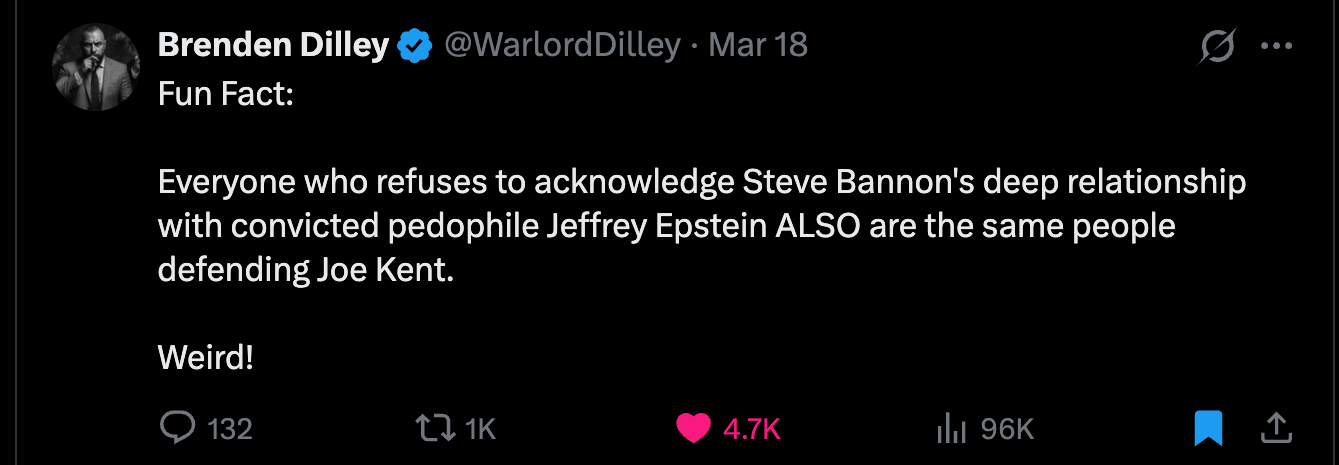
Consider each in turn, because the details matter.
Candace needs no introduction.
Carrie Prejean Boller was not merely honored as a Catholic Champion. She was honored specifically for anti-Zionist activism. This is the same woman who, while serving on a Religious Freedom Commission ostensibly representing all American Catholics, was photographed wearing a Palestinian flag pin. Not a cross. Not an American flag. A Palestinian flag, at a Religious Freedom Commission, before Trump removed her from the post. The irony would be almost comedic if the stakes were not real.
Gaza, the territory whose cause she wore on her lapel, is a place where religious freedom is not a contested policy question but an open graveyard. Non-Muslims would not merely be unwelcome there; they would be in mortal danger. Catholics specifically, the tradition she claims to champion, would face imprisonment, torture, or worse. Even Muslims who fail to perform sufficient devotion to Hamas’s particular interpretation of the faith have been routinely brutalized, thrown from rooftops, or shot in the streets. The idea that religious freedom and the Gaza cause are natural companions requires a caliber of motivated reasoning that most serious people cannot sustain with a straight face. Prejean Boller sustained it while wearing the pin to the meeting.
James Fishback was a featured and celebrated attendee, a man the Groyper ecosystem has elevated as one of its more intellectually presentable voices. The presentation does not survive scrutiny. Fishback has engaged in Holocaust denial, the now-familiar entry point for a generation of young men being radicalized through irony and incremental normalization. He also faces accusations from four separate underage women of grooming behavior, allegations that, in any movement that took its stated values seriously, would disqualify a person from being platformed at a Catholic celebration of any kind. At this one, he was a draw.
Michael Flynn completed the tableau. The former National Security Advisor, ex-convict, QAnon adherent and, most recently, documented propagandist for Chinese Communist Party-adjacent narratives was presented as a featured speaker at an event claiming to defend Western Christian civilization.
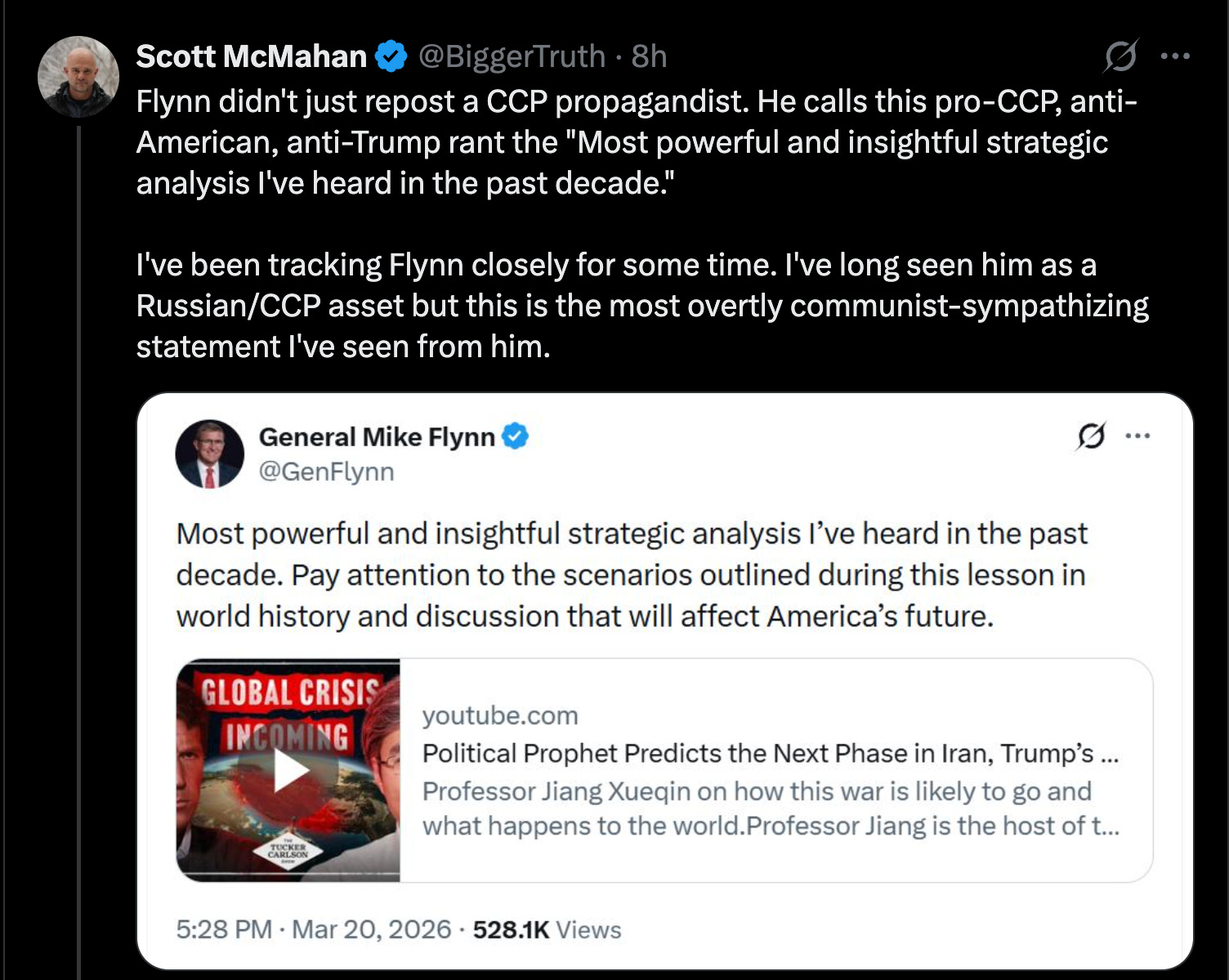
Flynn has spent recent years oscillating between apocalyptic Christian nationalist rhetoric and the kind of content that, when its origins are traced, leads back to sources with interests directly hostile to the United States. That a man who pled guilty to lying to the FBI, who led rally crowds in QAnon chants, and who has since become a useful vessel for CCP-friendly messaging was welcomed as a speaker at a celebration of Catholic religious freedom is not an irony the organizers appeared to notice. Or perhaps they noticed and did not care. The latter is more troubling than the former.
This is not about disagreement on policy. Serious Catholics disagree about policy. This is about something more fundamental: inversion again.
Christian language deployed as a shield for positions that contradict the moral architecture it claims to inhabit. Selective piety functioning as a vehicle for grievance. Scripture invoked alongside narratives that drift, sometimes openly and sometimes through euphemism, into distortion, moral equivalence, Holocaust minimization, and the fringes of conspiratorial thinking that, when followed to their conclusions, arrive at the same address they always have.
“Christ is King” has become less a declaration of theological conviction than a branding exercise. A slogan affixed to positions that bear little resemblance to Christian doctrine and a strong resemblance to the same anti-Western, anti-Israel frameworks long propagated by the far left, arriving now through a different door, wearing a different hat, but carrying the same maps to the same destinations. And sometimes, not always but with enough frequency to constitute a pattern, carrying the old cargo too: the insinuation, the implication, the nudge toward the conclusion that the real problem, behind all the problems, has a particular demographic character.
There is a specific theological irony here that should not be lost. The Christian tradition, at its most serious and intellectually rigorous, from Augustine through Aquinas through John Paul II, has insisted that antisemitism is not merely a political error but a theological one. That the Church’s covenant with its own origins, with the Hebrew scriptures it claims as its own, with the people from whom its Messiah came, cannot be squared with contempt for Jewish life, Jewish safety, or Jewish dignity. John Paul II called antisemitism “a sin against God and man.” The Second Vatican Council’s Nostra Aetate repudiated the charge of collective Jewish guilt with explicit, deliberate, historically significant language. These were not peripheral documents. They were the considered conclusions of a tradition doing serious moral work.
The people waving the cross at events where Holocaust denial circulates as subtext, where a Palestinian flag pin represents Catholic advocacy, where a QAnon ex-convict speaks about Christian civilization, have not engaged with any of this. They have not refuted it. They have simply ignored it, which tells you everything about the nature of the faith on display. Because what these figures wear is not Christianity. It is Christianity’s skinsuit, the costume of the tradition, hollowed out and pulled over something else entirely, worn by people who have absorbed none of its moral substance while retaining all of its social signaling. The cross as brand identity. The rosary as aesthetic. The language of sacrifice and covenant deployed by people who show no evidence of having seriously reckoned with what either word (or THE Word) demands of them.
A Christlike life, the actual content of the tradition as opposed to its iconography, is not compatible with grooming accusations, Holocaust minimization, QAnon apocalypticism, or wearing the flag of a territory that murders Christians to a meeting about Christian religious freedom. These are not edge cases or difficult theological questions requiring nuanced discernment. They are disqualifying on their face, by any serious reading of the tradition being invoked. That they are not treated as disqualifying tells you that the tradition is not actually being invoked. It is being worn. And there is a word, older than any of the figures in that room, for the practice of wearing another thing’s skin while something altogether different moves beneath it.
You cannot claim to defend Western civilization while platforming voices that consistently undermine its most reliable allies. You cannot position yourself as a guardian of tradition while elevating figures credibly accused of grooming children, denying genocide, and laundering foreign propaganda. You cannot invoke the persecution of Christians as a rhetorical flourish while honoring a woman who wore the symbol of their persecutors’ cause to a religious freedom meeting and apparently saw no contradiction worth addressing.

It does not hold. And it is not holding — and here, at least, there is something encouraging to report.
The actual leadership of the American Catholic Church has not been silent. Cardinal Dolan wrote plainly in The Free Press that Jew-hatred and Christianity are incompatible. Bishop Robert Barron was more pointed still: “I’m worried increasingly about this antisemitism on the right, people even on the Catholic right expressing themselves in a very antisemitic way. That’s dangerous business.” The USCCB issued a formal statement this week calling on Catholics to reject antisemitism and the conspiracies that fuel it, with Archbishop Sample noting that the Jewish community is attacked at a higher rate than any other religious group in America. The Orthodox Union’s Nathan Diament welcomed it, observing that it arrived precisely when “bad actors are weaponizing Catholicism to spread antisemitic views” — a description that fits the Catholics for Catholics dinner with uncomfortable precision.
The institutional Church has read the room that the Catholics for Catholics dinner couldn’t be bothered to find. The tradition is not confused about where it stands. The confusion belongs entirely to those wearing its skin.
Meanwhile, in New York, the left was conducting its own demonstration of the same principle: standards are not standards if they are not applied uniformly.
Zohran Mamdani's household provided yet another exhibit. His wife, Rama Duwaji, was fresh off a week in which she had been widely identified as an enthusiastic Hamas cheerleader after it emerged that she had liked dozens of posts depicting the slaughter and rape of Israeli civilians on October 7th — content that most people with functioning moral instincts would struggle to view at all, let alone endorse with an approving tap.
And then, as if to complete the picture, old posts of her own resurfaced, and they were exactly what a careful observer might have expected once the branding was stripped away.
Casual deployment of racial slurs. Language targeting gay people. Not isolated errors, not the awkward missteps of an otherwise coherent record, but a pattern, the kind of pattern that ends political careers overnight in any system that takes its stated principles seriously.
It did not end this one.
Because it does not.
Applauding or rationalizing the murder of Jewish civilians on October 7th, something Mamdani himself has navigated with conspicuous delicacy, carried no meaningful cost in the circles that matter to his coalition.
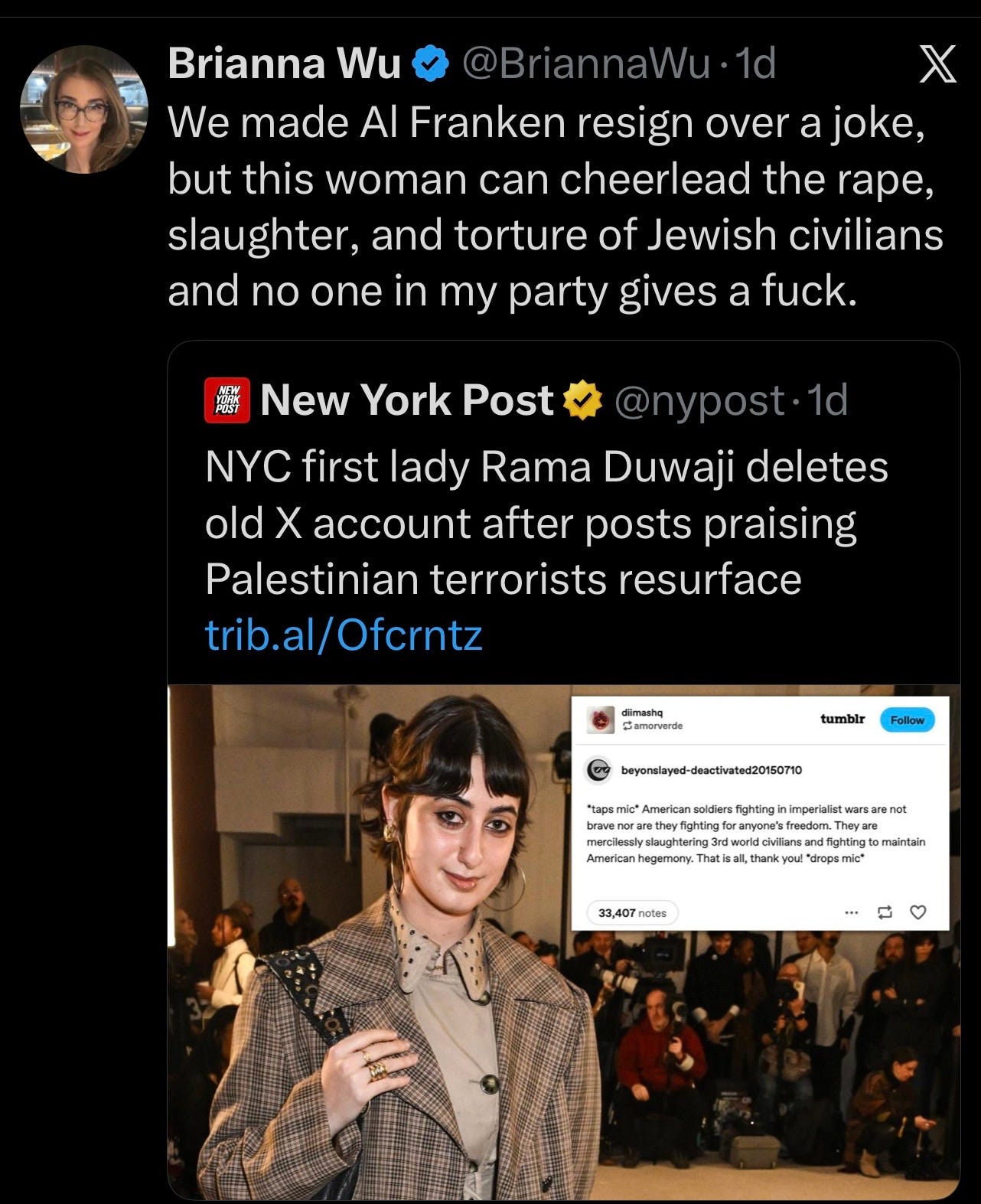
But direct equivalent language at other protected constituencies, and the machinery activates with extraordinary speed. Outrage. Condemnation. Institutional consequence. The full weight of a system that presents itself as committed to universal human dignity.
That is not hypocrisy. Hypocrisy implies a failure to live up to one’s actual beliefs. This is something more deliberate: hierarchy. A clearly ranked ordering of whose pain registers and whose does not, expressed not through stated policy but through the selective application of rules that are otherwise presented as universal.
And everyone can see where Jews sit within that hierarchy. The question is how many are willing to say it plainly.
Mamdani himself plays his assigned role with the reliability of a metronome. He could not let St. Patrick’s Day pass without converting the Gracie Mansion breakfast, a civic occasion, an expression of community, an event with its own history and meaning entirely separate from the grievances he carries, into another delivery vehicle for rehearsed lines about genocide and deafening silence. Irish heritage reduced to a backdrop. A celebration instrumentalized as a platform. The occasion itself beside the point, as occasions always are to those who carry a fixed script to every room they enter.
This is not leadership. Leadership requires reading the room. This is reflex, and reflex dressed up as moral urgency is the defining posture of a political moment that has confused passion with thought.
All of this, the Kent reversal, the Catholic masquerade, the Mamdani household, the selective silence, is not a collection of unrelated scandals.
It is a single phenomenon, expressing itself through different vehicles, converging on the same destination.
Moral inversion. Selective outrage. Strategic blindness deployed precisely where political convenience demands it. And beneath it all, threading through the performance wing of the right and the grievance caucus of the left alike, the oldest convergence of all: the figure of the Jew as universal explanation. The shape-shifting scapegoat who is, simultaneously, the rootless cosmopolitan and the ethno-nationalist; the godless communist and the rapacious capitalist; the open-borders globalist and the apartheid settler; too weak to be taken seriously and too powerful to be resisted; everywhere and nowhere; guilty of everything and accountable for nothing.
The logical contradictions have never mattered. They have never been the point. The point, in the medieval village, in the Weimar beer hall, in the Telegram channel, in the TikTok comment section, has always been the same: to provide a simple answer to a complex grievance, a face for an abstraction, a name for unnamed forces. The specific charge updates with the technology. The structure of the libel is eternal.
What the current moment has added is the infrastructure. Russia, China, and Iran, adversaries of the United States with distinct but overlapping interests in Western social fracture, have identified this particular narrative as a high-value asset and invested accordingly.
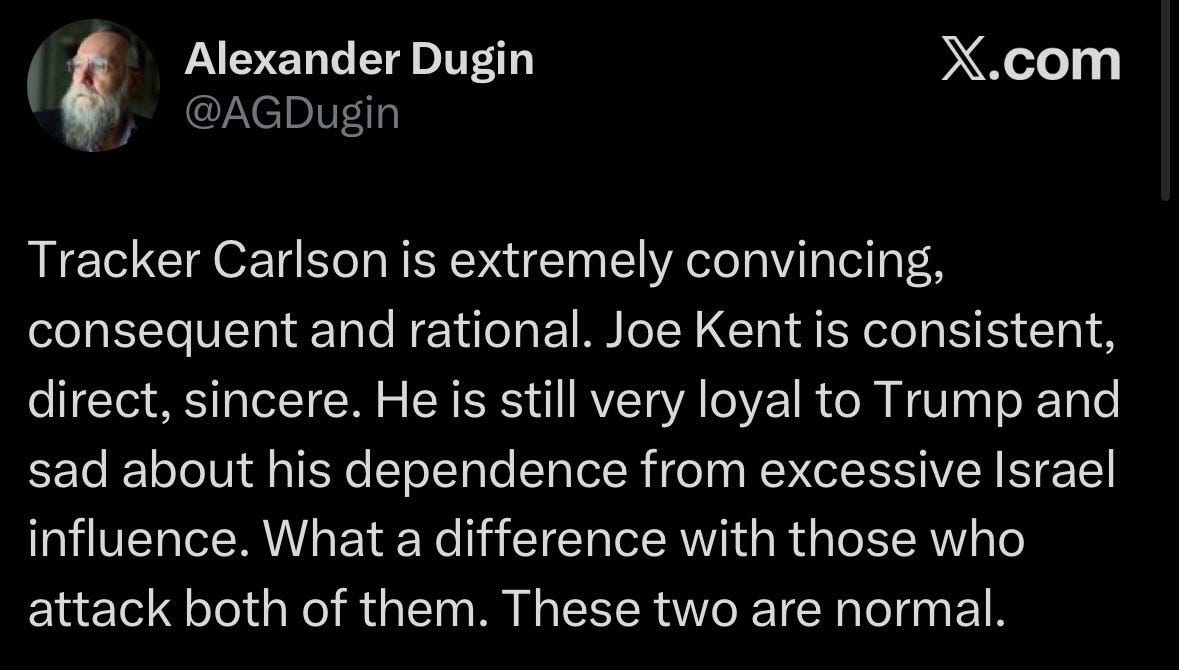
Russian influence operations documented by the Senate Intelligence Committee and the Stanford Internet Observatory seeded anti-Jewish content across American platforms with measurable consistency before and after October 7th. Iranian state media openly amplifies American voices making the case for Iranian foreign policy objectives, often without those voices appearing to notice or care. Chinese actors, identified by researchers at Oxford, the Atlantic Council, and elsewhere, have specifically targeted social fracture narratives, and few fractures have proven more algorithmically exploitable than this one.
The grifter does not need to be a paid agent to serve the agenda of a paid operation. He only needs to be responsive to the same incentives: clicks, views, followers, dollars. The algorithm rewards the scapegoat. The bots amplify the scapegoat. The foreign treasuries fund the infrastructure that makes the scapegoat trend. And the man who discovered that “unnamed forces” is more lucrative than “complex geopolitical dynamics” does not need a handler in Tehran or Moscow. He just needs to check his analytics.
This is what a convergence looks like from the inside: not a conspiracy, but a coincidence of incentives so profound it produces conspiracy-level coordination without requiring anyone to conspire. The red-green alignment, Islamist grievance politics and Western far-left anti-Zionism, found its Horseshoe mirror image on the dissident right, and all three movements arrived, by different roads, at the same address: the place where the complexity ends, where the argument stops, where the scapegoat stands waiting, as it has always stood, patient and useful and two thousand years old.
The destination, whatever road is taken to reach it, is always the same: the erosion of a Western Civilization strong enough to resist them, the undermining of the nation powerful enough to defend it, and the removal of the leader willing enough to try.
Which is why the backlash to Kent’s reversal feels qualitatively different from ordinary political friction.
It is not merely anger. It is recognition, the particular sensation of watching something name itself, of seeing the mechanism exposed while it is still in motion.
Recognition that a segment of the movement has drifted from skepticism into cynicism, from independence into opportunism, from questioning power to performing whatever narrative happens to be most lucrative in the current quarter. Recognition that this cannot continue without consequence, because movements, like markets, eventually correct. They punish inefficiency. They expose bad actors. They route around those who deliver noise at the expense of those who deliver results.
That correction is underway. You can hear it in the responses of voters, donors, and the rank and file who constitute the actual backbone of any political coalition, people who are not interested in ideological theater, who did not sign up for imported narratives that require them to unlearn what they can see with their own eyes, and who are increasingly unwilling to subsidize performances that treat their legitimate concerns as props.
The stakes, if they require stating, are not abstract.
Iran does not pause its nuclear program because acknowledging it is inconvenient for a podcast’s angle. Its proxies do not stand down because someone found a more profitable narrative. Domestic threats do not dissolve because they complicate a storyline that was working well until they didn’t. And antisemitism, the organizing principle of more catastrophes than any other single ideology in Western history, does not become less dangerous because it has been rebranded for the attention economy, because it now arrives in the form of Tweets and podcast ellipses rather than pamphlets and pogroms. The technology changes. The logic of the libel does not.
Reality, as Richard Feynman observed in the aftermath of Challenger, in a context very different but with the same essential lesson, does not accommodate itself to our preferences. “Nature cannot be fooled.” Neither, ultimately, can history. The bill for civilizational confusion arrives, always, and it is presented to people who had nothing to do with running up the tab.
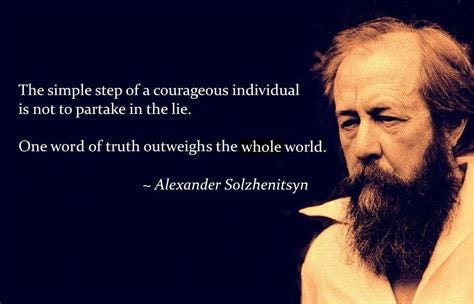
Spengler wrote that civilizations do not die from external assault alone; they die when they lose the will to distinguish truth from comfortable fiction. Solzhenitsyn, at Harvard in 1978, warned an audience that did not want to hear it that the West’s great vulnerability was not military but spiritual: the retreat from courage, from the willingness to say the difficult thing to people who do not wish to hear it. Neither man was describing a moment. They were describing a tendency, one that compounds quietly until the cost of ignoring it can no longer be deferred.
We are approaching that cost.
The scapegoat with the two-thousand-year résumé is back, wearing new clothes, running on new platforms, monetized by new business models, and amplified by the enemies of the civilization it is being used to destabilize. It is being worn as a skinsuit by people who call themselves Christians at dinner events, smuggled into foreign policy commentary by people who call themselves patriots, and turbocharged by adversarial states that call themselves our partners in peace. Naming it is not sufficient. But it is, as it has always been, the necessary beginning.
The only question, the only one that has ever mattered in any era and facing any version of this temptation, is whether enough people are willing to name what they are actually looking at.
You cannot fight what you refuse to see.
And you cannot afford, any longer, to perform the act of seeing while carefully, deliberately, and profitably not looking at all. - MK
Best of Twitter
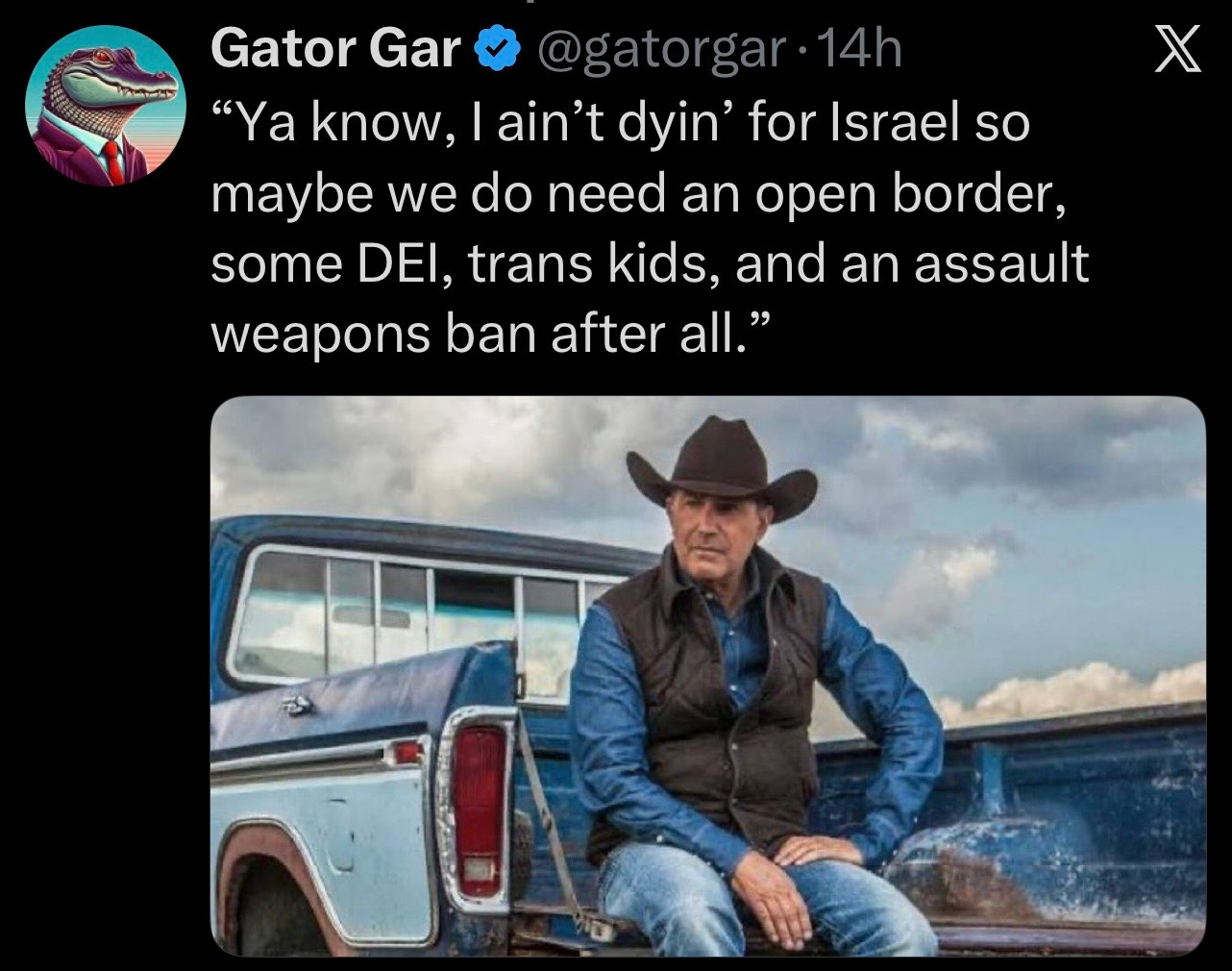
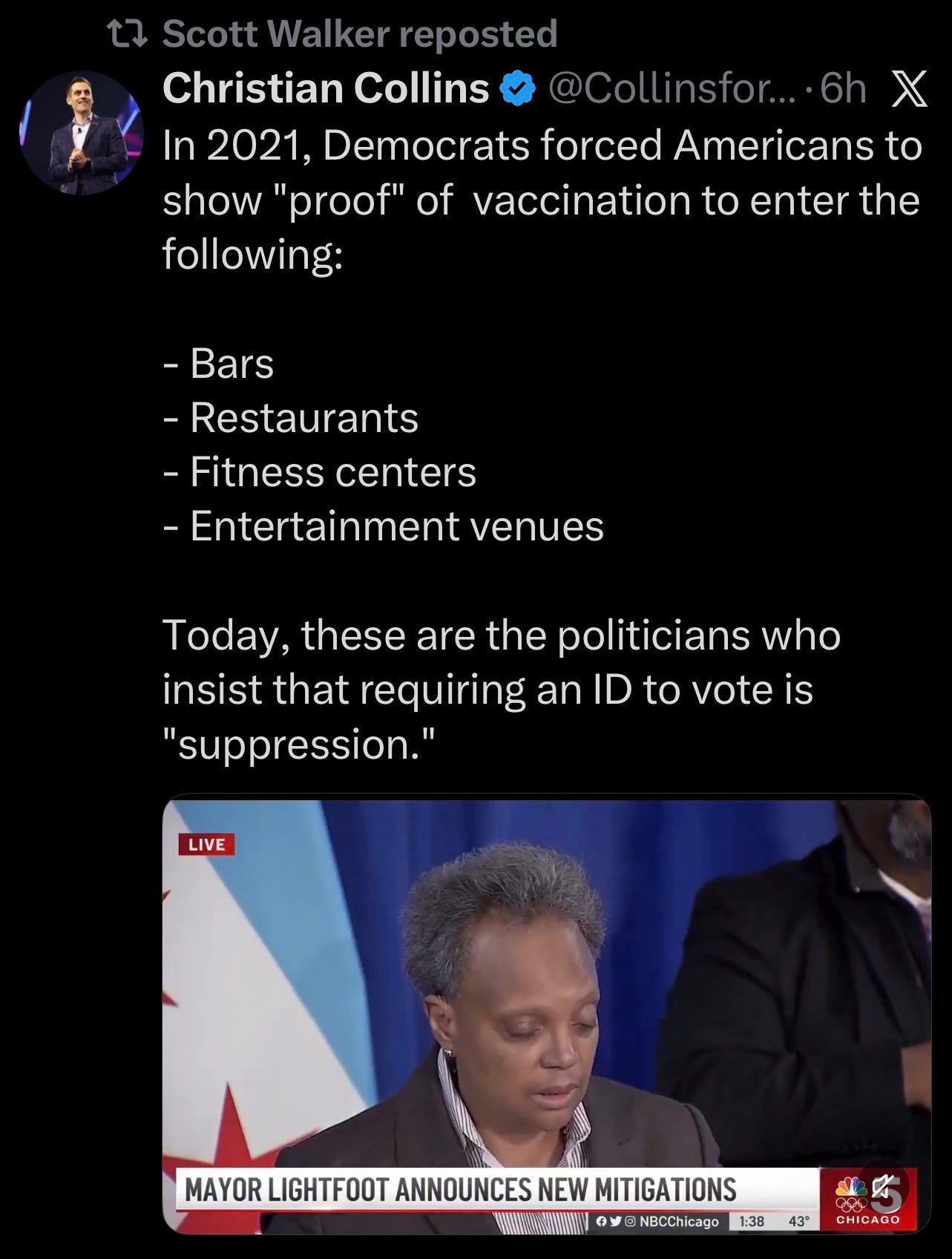
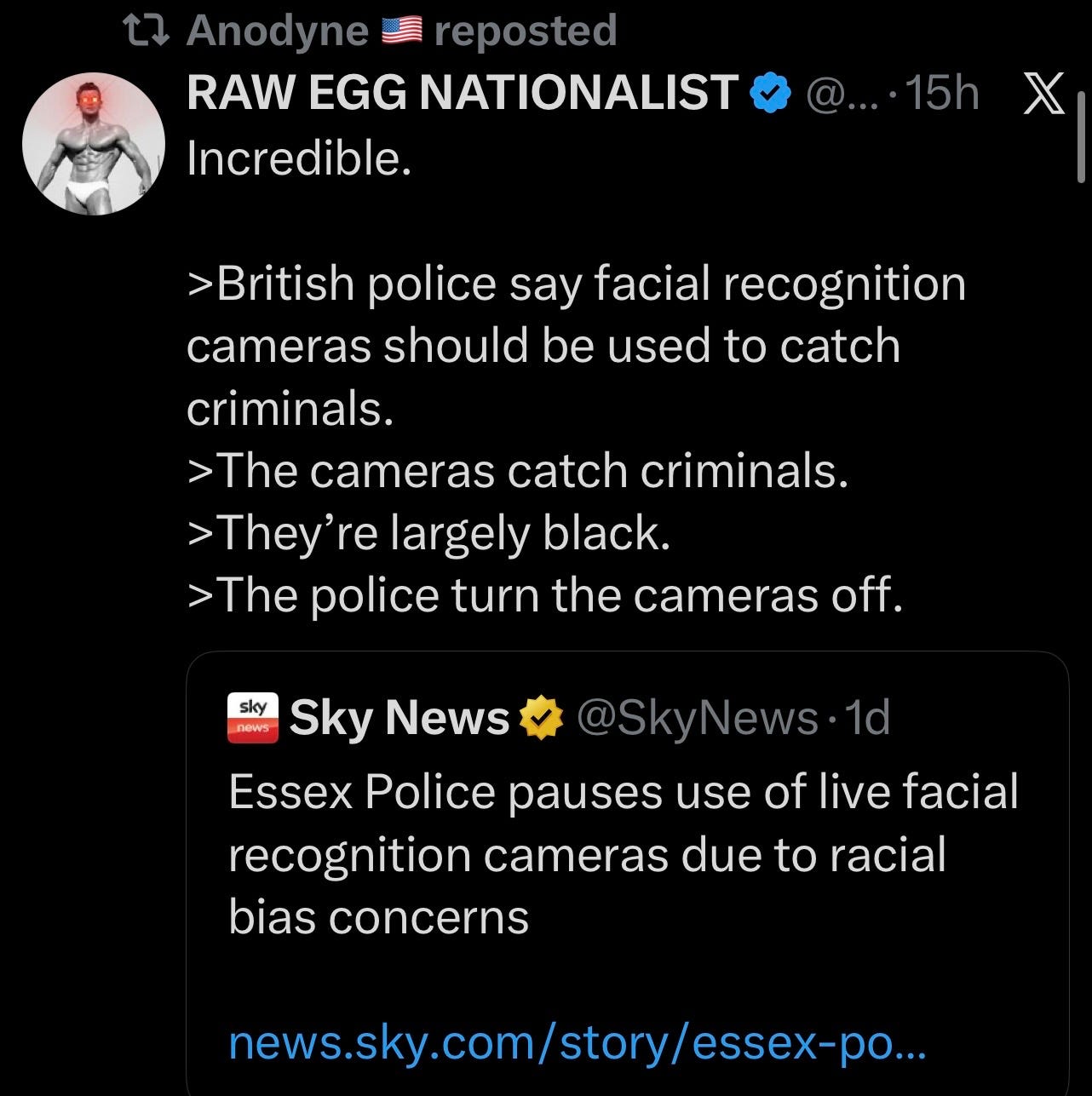


Memetic Warfare












Parting Words…

That’s it for this week folks. Hope you enjoyed!
Each week, Sovereign Sunday delivers battle-tested truths, bold analysis, and civilization-defending commentary you won’t find in legacy media echo chambers. No algorithms. No gatekeepers. Just raw signal in a world drowning in noise.
If this newsletter sharpens your mind, steels your spirit, or gives you ammo for the cultural battlefield—do your part:
Smash the like/heart button! (it helps us beat the bots).
Forward to friends, family, fellow patriots—anyone who’s tired of lies wrapped in politeness.
Leave me a comment
Become a Paid Subscriber and fuel the mission. This isn’t a hobby—it’s a war for the narrative. And we’re building an army of the awake.
This is reader-supported, freedom-fueled journalism. Your support makes it possible.
—Michael Kimelman
Founder, Sovereign Sunday
I'm genuinely conflicted here. I do think in the fullness of time this was the wrong move to attack Iran at this juncture. I'm based in the UK and have less skin in the game - but we see how this plays out. Iraq, Afghanistan, Syria Libya etc - I want my country sorted and getting sucked into foreign wars is not the answer. It's a distraction. Shame how the Right is splitting on both sides of the pond. We are split here with Reform and Restore Britain - with my money on the latter but the likely result is our falling out is going to allow the LGBT- race- communists to get in.
"The ancient observation holds, from Eve to Delilah, that there is no more reliable Achilles’ heel for a man of action than a corrupting intimate influence."
Mike: The most startling example of that is King Solomon. One of the wisest kings ever to rule Israel or any country in history. Look at the wisdom in the book of Ecclesiastes. And his conclusion after becoming one of the richest, wisest and most powerful man in history up to that time? "Everything is vanity". "A striving after wind".
He had 700 wives and 300 concubines. It was customary foreign policy in those times to marry the daughters of foreign kings to solidify treaties, ensure peace, and increase diplomatic power and not so much for sex. A massive harem was a symbol of extreme wealth, prestige, and imperial power in ancient Near East culture at that time. King Solomon had it all.
The result? Those wives worshipped false gods and turned him away from worshipping the one true God and creator, Yahweh. That is not just moral inversion, it is moral perversion.